
Verified as of August 2026. Immigration rules and appeal routes change without notice. Your own refusal notice, and the official pages of the country that issued it, outrank this article.
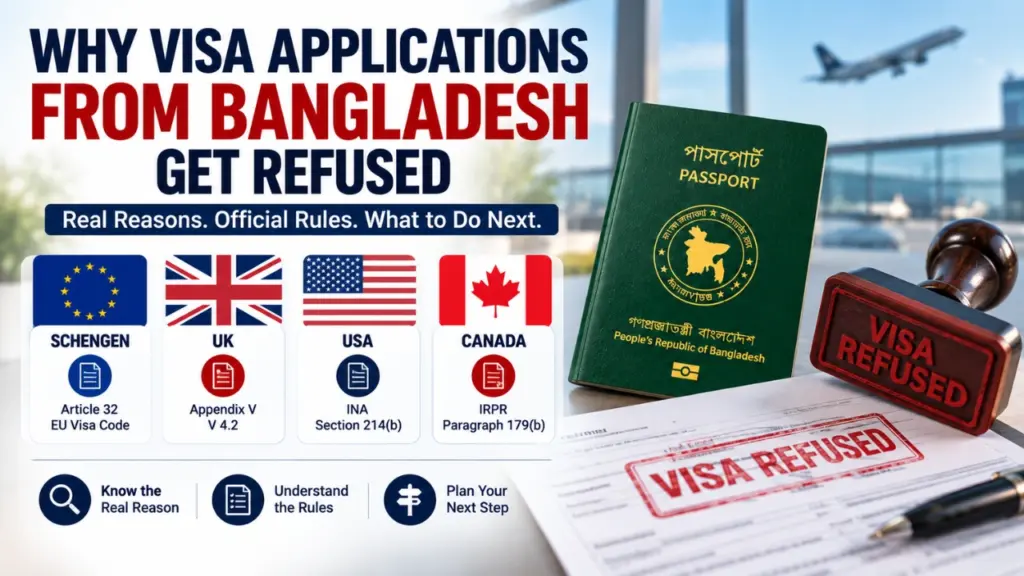
Short answer. Visa applications are not refused on a feeling. Every major destination refuses under named grounds published in law, and your refusal notice tells you which one applied. Schengen refusals are notified on a standard form set out in Annex VI of the EU Visa Code, with the grounds listed in Article 32. The UK refuses against the genuine visitor requirement at Appendix V, V 4.2. The United States refuses most visitor applications under the statutory presumption in INA section 214(b). Canada refuses most visitor applications under IRPR paragraph 179(b). Find your ground first. Everything else is guessing.
That is the difference between this page and the advice you have probably already read. “Insufficient funds” and “vague itinerary” are descriptions of symptoms. The grounds below are what the decision was actually made under.
A scope note, because this search is ambiguous
This article is for Bangladeshi passport holders whose application to another country was refused.
If you are a foreign national whose application for a Bangladesh visa was refused, that is a different system with different rules and this page will not help you. The authorities to approach are the Department of Immigration and Passports, Bangladesh, and the Bangladeshi mission in your own country, which issued or declined the visa.
Schengen: the grounds are a list, and you were ticked against it
This is the most decodable refusal in the world, and almost nobody in Bangladesh is told so.
Under the EU Visa Code, Regulation (EC) No 810/2009, a Schengen refusal is notified to the applicant using the standard form in Annex VI. The consular officer indicates the ground or grounds from a fixed list. Article 32 sets out those grounds. Quoted from the Regulation:
A visa shall be refused if the applicant:
- presents a travel document which is false, counterfeit or forged
- does not provide justification for the purpose and conditions of the intended stay
- does not provide proof of sufficient means of subsistence, both for the duration of the intended stay and for the return to his country of origin or residence, or for transit to a third country into which he is certain to be admitted, or is not in a position to acquire such means lawfully
- has already stayed for three months during the current six-month period on the territory of the Member States on a uniform visa or a visa with limited territorial validity
- is a person for whom an alert has been issued in the SIS for the purpose of refusing entry
- is considered to be a threat to public policy, internal security, public health or international relations
- does not provide proof of holding adequate and valid travel medical insurance, where applicable
And separately, under Article 32(1)(b), a visa shall be refused if there are reasonable doubts as to the authenticity of the supporting documents submitted, or the veracity of their contents, the reliability of the statements made by the applicant, or his intention to leave the territory of the Member States before the expiry of the visa applied for.
Read that last one twice. It is the one that catches most genuine applicants, and it is the only ground on the list that is about doubt rather than about a missing item. You cannot fix a doubt by adding a document to an incoherent file.
And there is a right of appeal. Article 32(3) states: “Applicants who have been refused a visa shall have the right to appeal. Appeals shall be conducted against the Member State that has taken the final decision on the application and in accordance with the national law of that Member State.” The deadline and the procedure are national, so the state that refused you is the one whose rules apply. This matters more than most Bangladeshi applicants realize, and it is one more reason the jurisdiction question in applying for Schengen from Bangladesh is worth getting right at the start.
United Kingdom: the genuine visitor requirement, and no appeal
The UK’s test is written into the Immigration Rules at Appendix V, V 4.2. The applicant must satisfy the decision maker that they are a genuine visitor, which means they will leave the UK at the end of the visit, will not live in the UK for extended periods through frequent or successive visits or make the UK their main home, genuinely seek entry for a permitted purpose, will not undertake prohibited activities, and have sufficient funds to cover all reasonable costs without working or accessing public funds.
The recourse position is the hard part. UK immigration practitioners describe Standard Visitor refusals as carrying no administrative review and no general right of appeal, with appeal available only on narrow human rights or discrimination grounds, leaving a fresh application or, rarely, judicial review, which tests the lawfulness of the decision rather than reweighing your evidence.
The practical consequence: for the UK, the first application is effectively the only one that gets a clean look at your circumstances as they stand. See the UK visit visa from Bangladesh for the full route.
United States: the 214(b) presumption
Section 214(b) of the Immigration and Nationality Act requires the consular officer to presume that every nonimmigrant visa applicant intends to immigrate permanently. The burden is on the applicant to overcome the presumption. If it is not overcome, the application is refused under 214(b).
Three things Bangladeshi applicants misread about this.
It is not a finding of wrongdoing. It is a finding that the presumption stood on that record.
It is not about the folder. Applicants with complete, accurate documents are refused under 214(b) all the time, because the section is about circumstances, not paperwork.
Reapplying is a fresh application. Practitioners describe a second application as needing new and relevant evidence or genuinely changed circumstances, rather than a resubmission.
The US route also now carries two additional conditions for Bangladeshi B1/B2 applicants, a visa bond requirement and a designated-airport restriction, both covered in the US visa interview in Dhaka.
Canada: IRPR 179(b)
Canadian visitor visa applications are assessed under the Immigration and Refugee Protection Regulations, paragraph 179(b): the officer must be satisfied that the applicant will leave Canada by the end of the period authorized for their stay. Canadian immigration practitioners describe failure on s.179(b) as the most frequently cited ground of visitor-visa refusal, assessed by weighing ties and circumstances, immigration history, and any prior overstay, on the balance of probabilities.
Canada’s refusal letters are typically brief. The fuller reasoning sits in the officer’s notes on the file, and Canadian practitioners commonly obtain those notes before deciding what to do next. That is a route worth knowing exists. See the Canada visitor visa from Bangladesh for the application itself.
What each ground actually asks of you
| The ground | What it is really testing | What genuinely addresses it |
|---|---|---|
| Purpose and conditions of stay not justified | Whether the trip described is coherent and real | Dates, bookings, purpose and funds that all describe the same journey |
| Insufficient means of subsistence | Whether you can pay for this trip and get home | Financial history consistent with the trip’s cost, in your own name, with the source of funds visible |
| Doubt about intention to leave | Whether your life continues here afterwards | The ordinary evidence of that life: work or business, study, family responsibility, property, and a travel record of returns made |
| Doubt about authenticity or veracity | Whether the file can be trusted | Nothing you can add later. This is a credibility finding |
| Travel medical insurance missing | A checklist item, where applicable | The correct policy, matching the stay |
| SIS alert, public policy, security | A legal or security bar | Specialist legal advice, not a resubmission |
The honest summary of that table: the top two rows are fixable by preparing better. The third is fixable slowly, by traveling and returning. The fourth is not fixable at all in the ordinary sense.
The one that does not get fixed
Every listicle on this topic promises that each rejection reason can be avoided next time. That is not true of one of them, and the pretense is the harmful part of the genre.
A finding that documents were not authentic, or that statements were not truthful, is a credibility finding, and it attaches to you rather than to the application. Biometrics mean your record follows you across systems and across years. A refusal is a decision about one trip. A misrepresentation finding is a decision about you.
So the single most valuable instruction on this page is negative. Never submit a bank statement that is not yours, an employment letter for a job you do not hold, an invitation from a person you have not met, or a booking you did not make. If anyone in Dhaka offers to arrange any of those for you, understand exactly what they are selling: a short-term improvement in your file and a long-term problem with your name. We do not recommend agents, brokers or consultancies for any part of this, and no legitimate one would offer you that.
What to do in the first week after a refusal
- Read the notice itself, slowly. For Schengen, identify the ticked ground on the Annex VI form. For the UK and the US, identify the paragraph or section cited.
- Find out what recourse exists for that country. Schengen: a right of appeal against the deciding member state, under that state’s national law and its deadline. UK Standard Visitor: generally no appeal or administrative review. US: a fresh application. Canada: a fresh application, with the officer’s notes commonly obtained first.
- Do not reapply the next day. A resubmission of the same case is usually the same case.
- Change the thing that was cited, not the thing you wish had been cited.
- Declare the refusal on your next application, honestly, wherever asked. Concealing a previous refusal converts a fixable problem into the unfixable one.
Gap note for the site owner: this article deliberately contains no case stories, no “applicants we have seen”, and no approval or refusal statistics, because we have no case file and inventing one on a page like this would be worse than leaving it thin. First-hand detail belongs here: what a refusal notice from a specific Dhaka mission looks like in hand, and what a genuine reapplication involved.
If you are earlier in the process and want to build a travel record before attempting a hard application, the visa-free and visa-on-arrival destinations for a Bangladeshi passport is the practical starting point.
FAQ
Why do Schengen visas get refused for Bangladeshi applicants?
Under Article 32 of the EU Visa Code, a Schengen visa is refused on named grounds, including a false or forged travel document, no justification for the purpose and conditions of the stay, no proof of sufficient means of subsistence for the stay and the return, an SIS alert, a threat to public policy or security, missing travel medical insurance where applicable, and reasonable doubts about the authenticity of documents, the veracity of their contents, the reliability of statements, or the intention to leave before the visa expires. The refusal is notified on the Annex VI standard form, which indicates which grounds applied.
Can I appeal a visa refusal from Bangladesh?
It depends entirely on the country. Article 32(3) of the EU Visa Code gives Schengen applicants a right of appeal, conducted against the member state that made the decision under that state’s national law. UK Standard Visitor refusals generally carry no appeal and no administrative review. US refusals under 214(b) are addressed through a fresh application. Read your own notice, which states the rights attaching to that decision.
Does a visa refusal affect future applications?
A refusal itself is a decision about one application, and most application forms ask you to declare previous refusals. Declare them honestly. What causes lasting damage is not the refusal but a finding that documents or statements were not genuine, which is a credibility finding recorded against you rather than against the file.
What is the most common reason applications from Bangladesh are refused?
Across the major destinations the recurring theme is the same one in different legal clothing: the decision maker was not satisfied the applicant would leave at the end of the visit. It appears as the Article 32(1)(b) doubt about intention to leave for Schengen, as the genuine visitor requirement at Appendix V 4.2 for the UK, as the section 214(b) presumption for the United States, and as IRPR 179(b) for Canada. This article does not publish refusal-rate percentages, because none could be traced to an official publication.
Should I use an agent to reapply after a refusal?
This site does not recommend agents, brokers or consultancies, and every one of the governments named here runs its application process directly. If anyone offers to supply documents, statements, invitations or bookings on your behalf that are not genuinely yours, refuse. That converts a refusal into a credibility finding that follows you across systems.
Checked August 2026. Sources named inline: the EU Visa Code, Regulation (EC) No 810/2009, retrieved from EUR-Lex, for the Article 32 grounds of refusal quoted above, for the Annex VI standard refusal form, and for the Article 32(3) right of appeal against the deciding Member State under its national law; gov.uk, for Immigration Rules Appendix V and the genuine visitor requirement at V 4.2; the Immigration and Nationality Act, section 214(b), for the presumption of immigrant intent; and the Immigration and Refugee Protection Regulations, paragraph 179(b), for the Canadian requirement that the officer be satisfied the applicant will leave Canada by the end of the authorized stay. Statements about recourse in the UK and Canada, and about how officers weigh ties and immigration history, come from UK and Canadian immigration practitioners rather than from a government page, and are attributed as such in the text. No refusal rate, approval rate or fee is published; the widely circulated figure attributing about 70 percent of US nonimmigrant refusals to 214(b) appears on practitioner blogs and could not be traced to a Department of State publication, so it is not reproduced. No case stories are included, because this site has no case file. Review interval: 90 days. This is documented policy, not immigration advice, and nothing here is a method for changing an officer’s decision.