
“What do I actually still need on paper in 2026?”
More than you would like, and the reason is not bureaucracy. It is that the moments a document is demanded are exactly the moments your phone is least usable.
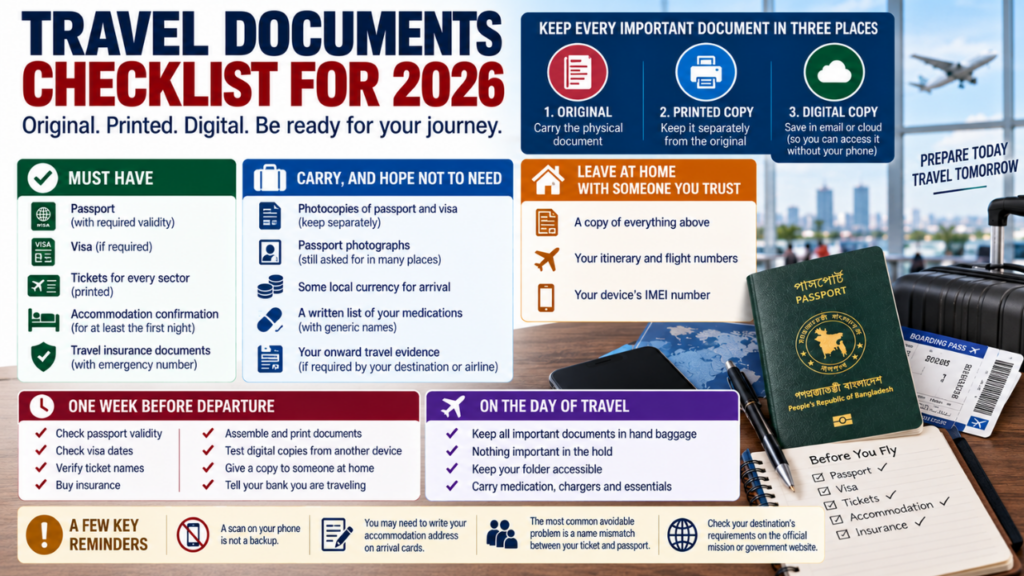
The three places every important document has to exist
This is the rule the whole page is built on, and it takes ten minutes to satisfy.
1. The original, carried. Passport, visa, and anything that has to be a physical document.
2. A printed copy, carried separately from the original. Different bag, different pocket, different person if you are traveling together.
3. A digital copy you can reach without your own phone. In an email you can sign into from any device, or in a cloud account whose password you know without a password manager on the missing phone.
Why the third one is worded that way: a scan stored only on the phone you have just lost is not a backup. It is the same single point of failure with extra steps.
Test it before you fly. Sign into that email account from a computer you do not normally use and see whether the documents are there and readable. Almost nobody does this and it takes four minutes.
What actually has to be paper
The check-in and boarding sequence. A boarding pass on a phone is fine until the phone is at three percent in a queue with no charger and no signal. Print it. It costs nothing and it removes a category of problem entirely.
Anything an immigration desk may want to hold or stamp. An officer cannot take your phone to a back office and will not want to.
Your accommodation address and a local phone number. You may be asked to write this on an arrival card while your phone is in a bag on a belt. Having it written down is the difference between thirty seconds and a scene.
Emergency contacts. Written, not stored.
Anything a mission asked you to bring in hard copy, which is on their own published list.
Insurance policy number and the insurer’s emergency line. The moment you need this is the moment you are least able to look it up.
The folder, item by item
Must have
Passport, with the validity your destination requires. This is the one that fails first and it fails at check-in rather than at a border, which is set out in the six-month passport validity rule, and who enforces it.
Visa, if your destination requires one. Which destinations do not is in visa-free countries on a Bangladeshi passport, and it is worth checking rather than assuming.
Tickets for every sector, printed.
Accommodation confirmation for at least the first night, with the address in a form you can copy onto a form.
Insurance documents, with the emergency number.
Carry, and hope not to need
Photocopies of the passport data page and the visa, separately from the originals.
Passport photographs. Still asked for in more places than people expect, and finding a photo booth in an unfamiliar city is a bad way to spend a morning.
Some local currency for arrival, and a card that you have told your bank you are traveling with.
A written list of the medications you take, with generic names rather than brand names. Brand names differ between countries and a generic name is understood everywhere.
Your onward travel evidence if your destination or your airline expects it, which is its own subject on this site.
Leave at home, with someone you trust
A copy of everything above, plus your itinerary and your flight numbers.
This is the version people skip and it is the one that helps when the other two are gone.
The digital half, done properly
Photograph or scan every document, including both sides where relevant.
Email them to yourself with a subject line you can search, and check that the attachments open.
Store them somewhere you can reach with a password you know, not one that lives only in an app on the missing phone.
Download offline copies of anything you will need without data. Maps, tickets, addresses.
Know your own phone number in international format, and know one family member’s, from memory. The phone that stores every number is the phone you are trying to replace.
And write down your device’s IMEI and keep it with the documents left at home, because it is the number a police report will ask for.
The pre-departure pass, one week out
Passport validity checked against the destination’s requirement.
Visa checked against your actual travel dates, and note that a visa’s validity window and your permitted stay are two different things.
Every name on every ticket checked against the passport spelling, exactly. This is the single most common avoidable problem at check-in.
Insurance bought and the policy number written down.
The documents folder assembled, printed, and split across bags.
The digital copies tested from a device that is not your phone.
The at-home copy given to someone.
Bank told you are traveling.
If this is your first international trip, all of this sits inside the wider sequence in your first international trip from Bangladesh, and the documents step is the one that rewards being done early.
The day itself
Everything you might need before boarding goes in hand baggage. Documents, medication, chargers, a change of clothes.
Nothing important goes in the hold. Not the passport, not the medication, not the insurance papers.
Keep the folder together and keep it somewhere you can reach without unpacking.
What we will not do
Tell you what your destination requires. That is on the mission’s own current page for your visa category.
Recommend an insurer, a service or an agent.
Publish a fee or a requirement list, because they change and the authority’s page is the source.
Coach you on any application.
FAQ
What travel documents do I still need on paper?
Boarding passes, your accommodation address and a local contact number for arrival cards, emergency contacts, your insurance policy number and emergency line, anything a mission asked for in hard copy, and photocopies of your passport and visa carried separately from the originals.
Is a photo of my passport on my phone enough?
Not on its own. A copy that exists only on the device you might lose is not a backup. Keep a printed copy carried separately and a digital copy you can reach from someone else’s device.
What is the most commonly missed item?
The accommodation address written down. It is asked for on arrival cards while your phone is often inaccessible, and it turns a thirty-second task into a problem.
What should I leave with someone at home?
A copy of every document, your itinerary and your flight numbers, plus your device’s IMEI. It is the version that helps when the other copies are gone.
How far ahead should I do this?
A week, so that anything missing can still be obtained. Passport validity in particular fails at check-in rather than at a border, and it is not fixable at the airport.
This page publishes no fees, no requirement lists and no destination rules, because those are set by each authority and change. The mission accredited to Bangladesh for your destination, and that country’s own immigration authority, are the sources.
General information, not immigration or insurance advice. It recommends no insurer, agent or service and does not coach any reader on any application.