
Verified as of August 2026. US visa policy for Bangladeshi nationals changed materially in 2026 and is still changing. Confirm everything below on travel.state.gov and the US Embassy in Bangladesh website before you apply or book.
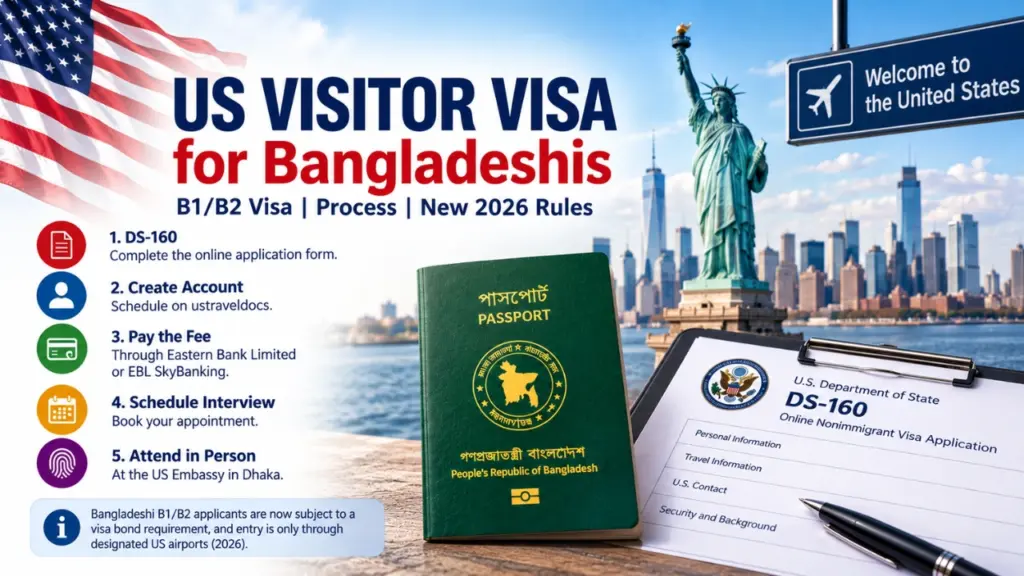
Short answer. For a B1/B2 visitor visa you complete the DS-160 form first, then create an account and schedule on ustraveldocs, pay the application fee through the published bank channel (Eastern Bank Limited branches or the EBL SkyBanking app), and attend an in-person interview at the Consular Section of the US Embassy in Dhaka with your passport, DS-160 confirmation page, appointment letter and deposit slip. Two things changed in 2026 that most guides have not absorbed: Bangladeshi B1/B2 applicants are now subject to a visa bond requirement, and travelers under that program may only enter the United States through a designated list of airports.
The second one is a booking constraint. Read the airports section before you buy a ticket into a city that is not on the list.
The sequence, start to finish
- DS-160. Complete the nonimmigrant visa application form. It is mandatory to complete the DS-160 before you schedule an appointment, and you should not schedule an interview before submitting the form.
- Create your ustraveldocs account. The US Embassy in Dhaka manages interview scheduling through the ustraveldocs system. You open an account with your passport details and select the visa category.
- Pay the fee. The system issues a payment form. Payment is made at an Eastern Bank Limited branch or through the EBL SkyBanking app. A reference number follows from the embassy, reported as within 24 hours or the next working day.
- Schedule the interview once the payment reference is active.
- Attend in person. Arrive at the Consular Section according to the entry date and time on your appointment letter. Bring your passport, the original DS-160 confirmation page, the appointment letter and the deposit slip.
- After the interview, the passport and any issued visa are returned through the published document delivery arrangement.
A non-refundable application fee applies and is published by the Department of State. We do not quote figures. And we are not going to tell you how long the wait for an appointment is: slot availability moves constantly, the trackers you will find in search results are third-party estimates, and no page can promise you a date.
What section 214(b) actually is
This is the single most useful thing to understand before a US interview, and it is a matter of statute rather than atmosphere.
Section 214(b) of the Immigration and Nationality Act creates a legal presumption that every nonimmigrant visa applicant intends to immigrate permanently to the United States. The consular officer is required by law to start from that presumption. The burden sits with the applicant to overcome it. If it is not overcome, the application is refused under 214(b).
Three consequences that matter for a Bangladeshi applicant.
A 214(b) refusal is not a finding that you did something wrong. It is a finding that the presumption was not overcome on that day, on that record.
“My documents were perfect” and “I was refused” are not a contradiction. 214(b) is about your circumstances and the ties that make a temporary visit credible, not about the thickness of a folder.
Reapplying is a fresh application. US immigration practitioners describe the position as needing new and relevant evidence, or genuinely changed circumstances, rather than a resubmission of the same case.
We are deliberately not publishing a list of things to say in the interview. Any page that offers you one is either padding or coaching you to perform, and performing is not what 214(b) measures. What we will say is this: do not submit or arrange any document that is not truthfully yours. A misrepresentation finding is a far worse outcome than a refusal, and it is durable.
For how the published refusal grounds compare across countries, see why visa applications from Bangladesh get refused. The UK Standard Visitor route is a useful contrast, because the UK tests you against a written rule in Appendix V while the US starts from a statutory presumption.
The visa bond program, and what changed for Bangladeshi applicants
Here is the 2026 change that most Bangladesh-facing pages have not integrated.
Bangladesh was added to the US visa bond program, reported as effective 21 January 2026. Under it, a Bangladeshi passport holder who is found otherwise eligible for a B1/B2 visa must post a refundable bond before the visa is issued. Reporting describes the legal basis as a Temporary Final Rule tied to section 221(g)(3) of the Immigration and Nationality Act, and describes the program as aimed at overstay compliance, with Bangladesh added alongside countries including Nepal, Nigeria, Uganda and Venezuela.
How the amount works, without us quoting a figure:
- The bond is set at one of several published tiers, not a single flat amount.
- The consular officer determines which tier applies at the time of your interview, and provides instructions on how to pay it. You do not choose it and you cannot pre-pay it.
- The tiering is reported as based on overstay-risk assessment drawn from the US Department of Homeland Security’s Entry/Exit Overstay Report.
- The bond is refundable when the conditions are met. The refund mechanics are the part you should read on the official source rather than anywhere else.
There is a further development you should check before relying on any of this. A Federal Register document titled “Visas: Visa Bond Program”, dated 3 August 2026, is reported to move the program from pilot to permanent and to change its parameters. We could not retrieve that document directly for this article. Read it yourself on federalregister.gov, and read the Department of State’s own visa bond page, before you plan around any version of this rule.
Two honest notes. First, the detail above comes from Bangladeshi reporting (The Business Standard and The Daily Star), from US immigration law firms tracking the rule, and from visa-industry news, because the US Embassy in Bangladesh pages returned a technical error on repeated attempts on 11 August 2026. Second, we do not publish the bond tiers, in line with this site’s standing rule against quoting amounts. That is a real limitation on this page, and the official source carries the current figures.
The designated airports rule
This is the part that can quietly ruin an itinerary.
Travelers admitted under the visa bond program may only enter the United States through designated ports of entry. The airports reported as designated in the January 2026 expansion are Boston Logan, John F. Kennedy in New York, Washington Dulles, Newark Liberty, Hartsfield-Jackson Atlanta, Chicago O’Hare, Los Angeles International, Toronto Pearson and Montreal-Pierre Elliott Trudeau. The last two are Canadian airports with US preclearance facilities.
What this means in practice for someone flying from Dhaka:
- Your first US entry point has to be on the designated list. A cheap routing that lands you first in a city not on that list is not a saving, it is a refused boarding or a refused entry.
- It applies to entry, so plan the inbound leg around it and confirm the current list before ticketing.
- The list can change. It was expanded once already in the January 2026 round, and the August 2026 Federal Register document may change it again.
Confirm the current designated airport list on travel.state.gov or in the Federal Register document before you buy a ticket, and tell your travel agent explicitly that this restriction applies to you. Most agents in Dhaka will not know it unprompted, because it is new and it applies to a specific set of nationalities.
The interview waiver route
The US Embassy in Bangladesh publishes an Interview Waiver Program, commonly called the drop box, for applicants who meet its published conditions, typically certain renewals. Eligibility criteria for interview waivers have been narrowed repeatedly across the US visa system in recent years.
Do not assume you qualify because you qualified before, and do not assume a consultancy’s version of the criteria. The embassy’s own Interview Waiver Program page is the only list worth acting on, and it states whether your category and circumstances are currently in scope.
What we cannot tell you, and why
This article deliberately does not describe what the interview is like.
We have not sat in the Consular Section in Dhaka. We do not know what the queue outside is like at 7am, how long people wait inside, how the security check runs, what the officers ask, or how the conversation feels. Every page you find that describes those things in confident detail is either written by someone who was there, or it is invented. On a page about an application that costs real money and cannot be appealed in the ordinary way, inventing it would be worse than leaving a gap.
Gap note for the site owner: first-hand detail belongs here. What the entry process at the Consular Section actually involves, what you were and were not allowed to carry in, how the queue moved, what the window interaction was like in practice. That is the section this article is missing, and no amount of research substitutes for it.
If you want the practical layer we can source, which embassies and visa centers are actually in Dhaka covers where the missions and application centers are, and the visa-free and visa-on-arrival list for a Bangladeshi passport covers the destinations that need none of this. Readers weighing the US against Europe should also read the Schengen application from Bangladesh, which fails or succeeds on an entirely different question: which member state is even allowed to examine your file.
FAQ
What is the process for a US visa interview in Dhaka?
Complete the DS-160 form first, create an account and schedule on ustraveldocs, pay the application fee through an Eastern Bank Limited branch or the EBL SkyBanking app, wait for the reference number, then attend the in-person interview at the Consular Section of the US Embassy in Dhaka with your passport, DS-160 confirmation page, appointment letter and deposit slip.
Do Bangladeshi applicants have to pay a visa bond for a US B1/B2 visa?
Reporting from The Business Standard and The Daily Star, and from US immigration law firms tracking the rule, describes Bangladesh as added to the US visa bond program effective 21 January 2026, under a Temporary Final Rule tied to section 221(g)(3) of the Immigration and Nationality Act. An applicant found otherwise eligible must post a refundable bond, set at one of several published tiers by the consular officer at the time of interview. Confirm the current position on travel.state.gov, because a Federal Register document dated 3 August 2026 is reported to change the program.
Which US airports can I enter through under the visa bond program?
Entry is limited to designated ports of entry. The airports reported as designated in the January 2026 expansion are Boston Logan, JFK, Washington Dulles, Newark Liberty, Atlanta Hartsfield-Jackson, Chicago O’Hare, Los Angeles International, Toronto Pearson and Montreal-Pierre Elliott Trudeau. The list has already changed once, so confirm it on the official source before booking your inbound flight.
What does a 214(b) refusal mean?
Section 214(b) of the Immigration and Nationality Act requires the consular officer to presume that every nonimmigrant visa applicant intends to immigrate permanently, and places the burden on the applicant to overcome that presumption. A 214(b) refusal means it was not overcome on that record. It is not a misconduct finding. Reapplying is a fresh application and generally requires new evidence or genuinely changed circumstances.
How long is the wait for a US visa appointment in Dhaka?
This guide does not publish a figure. Appointment availability moves constantly and the wait-time trackers in search results are third-party estimates rather than commitments. Check the current position through your ustraveldocs account and the US Embassy in Bangladesh website, and do not buy non-refundable tickets before your visa is in hand.
Checked August 2026. Sources named inline: travel.state.gov and the US Embassy in Bangladesh (bd.usembassy.gov), for the DS-160-before-scheduling rule, ustraveldocs scheduling, the Eastern Bank Limited and EBL SkyBanking payment channel, the reference-number step, the documents to bring to the Consular Section, and the Interview Waiver Program page. Note that bd.usembassy.gov pages returned a “Technical Difficulties” error on direct fetch on 11 August 2026, so those facts are carried from the ranking search results for those official pages rather than from a successful direct read, and this is stated rather than hidden. Section 214(b) and section 221(g)(3) of the Immigration and Nationality Act are cited as statute. The visa bond program details, the 21 January 2026 effective date for Bangladesh, the tiered refundable bond set by the consular officer at interview, the Entry/Exit Overstay Report basis, and the nine designated airports are reported by The Business Standard, The Daily Star and US immigration law firms tracking the Temporary Final Rule, and are attributed as reporting rather than as a government statement. A Federal Register document titled “Visas: Visa Bond Program” dated 3 August 2026 exists and could not be retrieved directly; readers are routed to it. No visa fee and no bond amount is published, per this site’s standing rule against quoting amounts, which is a stated limitation of this page. No appointment wait time is promised and no approval odds are claimed. Review interval: 60 days. This is documented process, not immigration advice.