
Ramon Bass

Top 10 Attractions in Arkansas: What to See and Why

The top 10 attractions in Arkansas are Hot Springs National Park, Crater of Diamonds State Park, Crystal Bridges Museum of American Art, Buffalo National River, Eureka Springs, Blanchard Springs Caverns, Petit Jean State Park, Little Rock Central High School National Historic Site, the Clinton Presidential Center, and Garvan Woodland Gardens. Together they cover thermal baths, diamond hunting, world-class art, a free-flowing river, a Victorian mountain town, and civil rights history. Arkansas calls itself the Natural State, but the best trips mix outdoor scenery with a few surprising museums and landmarks. This list is ordered by how well each place delivers something you cannot get elsewhere, then grouped by region at the end so you can plan a route instead of zigzagging across the map. Quick Comparison # Attraction Region Cost to enter Best for 1 Hot Springs National Park Central (Ouachitas) Free park admission History, thermal baths 2 Crater of Diamonds State Park Southwest Paid (check current fee) Families, treasure hunting 3 Crystal Bridges Museum Northwest Free general admission Art, architecture, trails 4 Buffalo National River North (Ozarks) Park access, outfitters charge Floating, hiking 5 Eureka Springs Northwest (Ozarks) Free to walk, attractions vary Architecture, small-town charm 6 Blanchard Springs Caverns North Central Paid tours Cave tours 7 Petit Jean State Park Central Park access, lodging extra Waterfall hike, lodge stay 8 Little Rock Central High School NHS Little Rock Check with National Park Service Civil rights history 9 Clinton Presidential Center Little Rock Paid museum Presidential history 10 Garvan Woodland Gardens Hot Springs area Paid (seasonal events extra) Gardens, holiday lights Fees change, so confirm current prices on each official site before you go. 1. Hot Springs National Park Congress set aside the thermal springs here as the Hot Springs Reservation in 1832, decades before Yellowstone became a national park in 1872. That makes Hot Springs the oldest federally protected area in the National Park Service system. The park covers about 5,500 acres, charges no admission, and has more than 25 miles of hiking trails. The centerpiece is Bathhouse Row, a National Historic Landmark District with eight preserved bathhouses built mostly in the early twentieth century. The Fordyce Bathhouse, which opened in 1915, now serves as the park’s visitor center and museum. The Buckstaff and Quapaw bathhouses still offer traditional thermal soaks, and the Superior Bathhouse Brewery brews beer with thermal water. Walk the brick Grand Promenade behind the row, and fill a bottle at the free spring-fed taps. Plan at least half a day if you want a soak, a museum stop, and a short hike. 2. Crater of Diamonds State Park This park near Murfreesboro lets the public search the eroded surface of a volcanic crater for natural diamonds, and the rule is finders keepers. The search area is a plowed field of about 37 acres, and any rock or mineral you pick up is yours. Park staff will identify and register your finds at no charge. The numbers show how real the odds are. Park records say visitors have found more than 37,000 diamonds since it became a state park in 1972, a count current as of January 2026. The largest diamond ever unearthed in the United States came from this field: the 40.23-carat Uncle Sam. Diamonds here come in white, brown, and yellow. Local news coverage of the park in 2024 reported an average of one to two diamonds found per day, so treat it as a fun day out with a real chance, not a guarantee. The visitor center displays uncut diamonds and explains three recommended search techniques. 3. Crystal Bridges Museum of American Art Crystal Bridges opened in Bentonville on November 11, 2011, founded by Alice Walton and designed by architect Moshe Safdie. Pavilions sit around two spring-fed ponds, and a glass-enclosed bridge holds a restaurant and coffee bar. The permanent collection spans five centuries of American art, from early portraits to contemporary work, and general admission is free. The grounds matter as much as the galleries. Five miles of sculpture and walking trails connect the museum’s 120-acre park to downtown Bentonville, so you can pair a gallery visit with a walk or bike ride into town. Some special exhibitions may charge a fee, and the museum has been closed one day a week in the past, so check its calendar before you drive. It is the strongest rainy-day option on this list. 4. Buffalo National River Designated on March 1, 1972, the Buffalo was the first national river in the United States. The National Park Service protects 135 miles of its channel, and the river is one of the last free-flowing rivers in the country. Limestone bluffs, forested hollows, and clear pools line the route, and spring rains bring the best floating on the upper sections. Hikers should head for Hemmed-In Hollow Falls, a waterfall of roughly 209 feet that is often described as the tallest between the Rockies and the Appalachians. Wildlife watchers can look for elk in Boxley Valley at dawn and dusk. The river was named an International Dark Sky Park in June 2019, so a night under the stars here is a real part of the experience. Local outfitters rent canoes and know which stretches suit the current water level. 5. Eureka Springs Founded on July 4, 1879 around natural springs, Eureka Springs grew fast, and its Victorian buildings survive today. The entire town is listed on the National Register of Historic Places. Streets curve and climb through the hills, so plan to walk rather than drive. Two landmarks stand just outside downtown. Thorncrown Chapel, completed in 1980 and designed by Fay Jones, rises 48 feet in the woods with about 6,000 square feet of glass and 425 windows. Christ of the Ozarks, a seven-story statue erected in 1966, overlooks the area from the grounds of The Great Passion Play. The 1886 Crescent Hotel crowns a hilltop above the historic district. Thorncrown keeps limited hours in March and December, so check before you go in the off

Top 10 Attractions in Arkansas: What to See and Why Read More »
Top 10 Attractions in Arizona and the Rules Each One Runs On

The top 10 attractions in Arizona are the Grand Canyon, Antelope Canyon, Horseshoe Bend, Sedona’s red rocks, Monument Valley, Havasu Falls, Saguaro National Park, Petrified Forest National Park, Lake Powell and Meteor Crater. Most sit in northern Arizona, and several are on Navajo or Havasupai land rather than federal land, so each one has its own permits, fees and rules. That last point is what most Arizona lists skip. Arizona draws more than 40 million visitors a year, and a lot of trips go wrong not because people pick the wrong place, but because they show up at a tribal park with a federal pass or arrive at a slot canyon without a booked tour. This guide ranks the ten best attractions and tells you who manages each one, so you know what to book before you go. Who runs what: the quick planning table Attraction Managed by Do you need to book ahead? Grand Canyon National Park Service Lodging and camping, yes Antelope Canyon Navajo Nation Yes, guided tour only Horseshoe Bend Navajo Nation (Page area) No, pay at the lot Sedona Coconino National Forest and city Parking pass for many trailheads Monument Valley Navajo Nation Tribal Park Only for guided tours Havasu Falls Havasupai Tribe Yes, permit required Saguaro NP National Park Service No Petrified Forest NP National Park Service No Lake Powell National Park Service (Glen Canyon) For boat tours, yes Meteor Crater Private No 1. Grand Canyon National Park The Grand Canyon is the reason most people come to Arizona. The park covers 278 miles of the Colorado River and the uplands beside it, and it sits on the ancestral homelands of 11 present-day Tribal Communities, according to the National Park Service. Roughly 5 million people visit each year, and the large majority use the South Rim, which stays open all year. Three things matter for planning. First, entrance passes are valid for up to seven days. The standard fee runs from $20 to $35 depending on how you arrive, and since January 1, 2026, nonresident visitors aged 16 and over pay an extra $100 per person unless they hold an America the Beautiful Non-Resident Annual Pass. Second, the Desert View entrance, about 74 miles from Flagstaff, is usually less crowded than the main South Entrance. Third, the North Rim is seasonal, typically mid-May to mid-October, so check it before you build a route around it. 2. Antelope Canyon Antelope Canyon, near Page, is the most photographed slot canyon in the Southwest. Water has carved and polished the sandstone into smooth curves and layered colors, and in the Upper canyon, shafts of light drop through the narrow opening overhead. You cannot walk in alone. The canyon is on Navajo land and a guided tour is required. Upper Antelope is flatter and tends to be more crowded and more expensive, while Lower Antelope is a narrow walk of roughly a quarter mile that involves ladders, so it suits you better if you are comfortable climbing. Antelope Canyon X is a quieter third option. Most operators do not allow tripods, and tours can be cancelled for weather, so book early and keep a flexible day. 3. Horseshoe Bend Horseshoe Bend is the quickest big payoff on this list. The Colorado River makes a roughly 270 degree turn around a rock formation below the viewpoint, and the walk from the lot is short. It sits about 10 minutes from the Antelope Canyon tour offices, which is why most visitors pair them on one day. Entry is free but you pay for parking; at last check the fee was about $10 per vehicle, so confirm it before you go. One safety note: only a small section of the rim is fenced. The drop is high, and visitors who step past the barrier for a photo are taking a real risk. Go near sunrise or late afternoon to avoid the midday glare and the biggest crowds. 4. Sedona Sedona is the best-known red rock town in Arizona, surrounded by sandstone buttes, pine forest and canyon walls. It works as a base for hiking, scenic drives and the Chapel of the Holy Cross, a chapel built into the rock that is one of the best-known architectural landmarks in the state. Many Sedona trailheads sit inside Coconino National Forest and require a recreation pass for parking, so check the forest service’s current guidance before you arrive. Sedona is also a convenient hub for day trips toward Flagstaff, the Grand Canyon and the Verde Valley. Spring and fall are the most comfortable seasons for walking the trails. 5. Monument Valley Monument Valley is the landscape people picture when they think of the American West. It is a Navajo Tribal Park, not a national park, and America the Beautiful and other federal passes are not accepted. You pay the park’s own per-person entry fee, which was $8 before the Navajo Nation announced fee increases effective January 1, 2026, so confirm the current amount. The 17-mile Valley Drive is a rough dirt loop that you can drive yourself in a suitable vehicle, though RVs, camper vans and motorcycles are prohibited. Large parts of the park, including Mystery Valley, are open only with a licensed Navajo guide, and guided tours generally run from about $60 to over $120 per person depending on length. Dogs are not allowed. Plan a half day for the drive and add a guided tour if you want to see the backcountry. 6. Havasu Falls Havasu Falls is the turquoise waterfall hidden inside the Havasupai Reservation, and it is the hardest permit on this list. You must hold a reservation to hike in. The trail to the village and campground is roughly 10 miles each way, and the reservation covers three nights. The 2026 rates were $455 per person for the campground and $2,277 per lodge room for up to four people. Permits are not transferable, the trail is closed in December and January, and dogs are not allowed. In 2026 the

Top 10 Attractions in Arizona and the Rules Each One Runs On Read More »

Top 10 Attractions in Alaska 2026 Planning Guide

The top 10 attractions in Alaska are Denali National Park, Kenai Fjords National Park, Glacier Bay National Park, Mendenhall Glacier, Katmai’s Brooks Falls, the Fairbanks northern lights, Wrangell-St. Elias National Park, Anchorage’s Alaska Native Heritage Center and Anchorage Museum, the Alaska SeaLife Center, and the Alaska Railroad. Most are summer destinations, but the aurora season runs from August 21 to April 21. Alaska is too big to see in one trip, so the smartest way to use this list is to pick a home base (Anchorage, Juneau, Fairbanks or Seward) and build outward. Each entry below says what you will actually see, how you get there, and when it is worth going. Where something has changed recently, we say so. Alaska’s Top 10 Attractions at a Glance # Attraction Region Best for Main window 1 Denali National Park Interior Mountain views, wildlife Summer bus season 2 Kenai Fjords National Park Southcentral Tidewater glaciers, boat tours Summer 3 Glacier Bay National Park Southeast Glacier cruising, whales Summer 4 Mendenhall Glacier Southeast Easy glacier access by road Grounds open year-round 5 Brooks Falls, Katmai Southwest Bears catching salmon July and September 6 Fairbanks aurora Interior Northern lights August 21 to April 21 7 Wrangell-St. Elias Southcentral Wilderness, mining history Summer 8 Anchorage cultural sites Southcentral Alaska Native cultures, art Check current hours 9 Alaska SeaLife Center Seward Marine animals, rainy days Year-round 10 Alaska Railroad Statewide Scenic travel Mid-May to mid-September (main routes) 1. Denali National Park and Preserve Denali National Park covers more than six million acres and centers on Denali, which the National Park Service lists at 20,310 feet, the tallest peak in North America. One road, the 92 mile Denali Park Road, reaches into the interior. Private vehicles can use only the first 15 miles, so most visitors ride a park bus to look for bears, moose, caribou, sheep and wolves. The mountain is often hidden by cloud and cannot be seen from the park entrance, so build in more than one day. Current access (October 2026). The Pretty Rocks landslide closed the road near mile 45 in 2021, and buses have turned around at mile 43 ever since. The National Park Service announced on September 3, 2026 that the roughly 475 foot Pretty Rocks Bridge is finished, and it expects full bus service along the road, including Eielson Visitor Center, Wonder Lake and Kantishna, to resume in 2027. If you want the deep-park day, plan for summer 2027. 2. Kenai Fjords National Park Kenai Fjords is where the Harding Icefield, about 700 square miles of ice, meets the sea. Per the National Park Service, at least 38 glaciers flow from the icefield. The town of Seward, roughly 125 to 130 miles south of Anchorage, is the gateway. There are two ways in. By car, you can reach Exit Glacier, the only part of the park connected to the road system. From the Exit Glacier trailhead, the Harding Icefield Trail is a strenuous 4.1 mile one way climb with about 3,500 feet of elevation gain, ending at a view over the ice. By water, boat tours leave Seward’s small boat harbor, cross Resurrection Bay and reach tidewater glaciers such as Aialik and Holgate, with sea otters, puffins, Steller sea lions, orcas and humpback whales along the way. The Exit Glacier Nature Center is staffed from Memorial Day weekend through Labor Day, so summer is the practical window. 3. Glacier Bay National Park and Preserve Glacier Bay holds about 3.3 million acres of mountains, fjords, temperate rainforest and tidewater glaciers, and it is part of a UNESCO World Heritage Site shared with Wrangell-St. Elias and two Canadian parks. Roughly 200 years ago, ice filled almost the whole bay. It has since retreated to leave a fjord about 65 miles long with 11 tidewater glaciers still calving into it. This is mainly a water-borne attraction. The National Park Service reports 691,387 cruise ship passengers in 2024 and says over 90 percent of visitors never set foot on land inside the park. If you want to go ashore, the park sits about 60 miles west of Juneau, and the Alaska Marine Highway runs scheduled ferries from Juneau to Gustavus, which connects by a roughly 10 mile road to the park’s Bartlett Cove base. Glacier Bay Lodge has just 48 rooms, so book early. Cruise vessels have limited summer use days, with June through August the main season. 4. Mendenhall Glacier, Juneau Mendenhall is the easy one. The 13 mile glacier flows from the 1,500 square mile Juneau Icefield, which feeds 38 large glaciers, and it sits about 12 to 13 miles from downtown Juneau inside the Tongass National Forest. Alaska’s tourism sources describe it as the only glacier in Southeast Alaska reachable by road. The Forest Service visitor center, dedicated in 1962 as the first of its kind in the nation, has a glacier observation area and a 15 minute film. Trails lead along Mendenhall Lake to Nugget Falls, which drops 377 feet in two tiers. Black bears fish Steep Creek during the salmon run, so keep your distance and watch for trail closures. Stay well back from the glacier face and lake ice, which can be thin. Two practical notes: parking and the main trails do not require a fee, though the visitor center does, and the visitor center runs only intermittently in April and October. 5. Brooks Falls and Katmai National Park Katmai is one of the most remote places on this list and one of the best for bears. At Brooks Camp, brown bears stand at the lip of Brooks Falls to catch leaping salmon. The National Park Service says viewing is best in July and September: in July most bears fish at the falls, and in September most are at the mouth of the Brooks River. Expect crowds in July. The Falls Platform holds 40 people, rangers keep a waiting list when it is full, and waits commonly pass 90 minutes, especially midday. In peak season more

Top 10 Attractions in Alaska 2026 Planning Guide Read More »

alabama_top_10_attractions_by_region

Top 10 Attractions in Alabama: What to See and Where

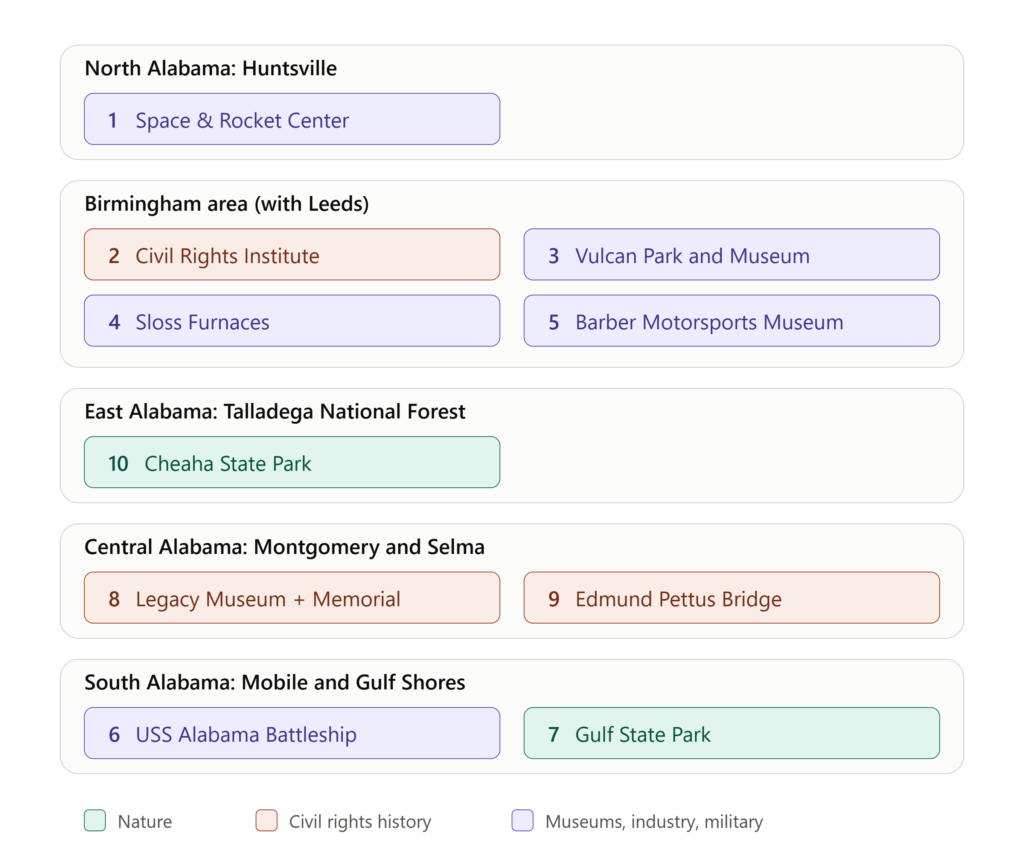
The top 10 attractions in Alabama are the U.S. Space & Rocket Center in Huntsville, USS Alabama Battleship Memorial Park in Mobile, the Birmingham Civil Rights Institute, the Legacy Museum and National Memorial for Peace and Justice in Montgomery, Gulf State Park in Gulf Shores, Cheaha State Park, Vulcan Park and Museum, the Barber Vintage Motorsports Museum, Sloss Furnaces, and the Edmund Pettus Bridge in Selma. Most “best of Alabama” lists hand you ten names and stop there. Alabama is a long drive from top to bottom, so the order in which you visit matters as much as the list itself. This guide groups each attraction by region, says how much time to budget, and shows which stops pair well on a single trip. Ticket prices and hours change often, so we send you to each official site rather than print numbers that may be out of date. North Alabama: Huntsville 1. U.S. Space & Rocket Center Huntsville is where much of America’s rocket work happened, and the U.S. Space & Rocket Center is the place to see it. It is a Smithsonian Affiliate and the official visitor center for NASA’s Marshall Space Flight Center. The headline exhibit is Saturn V Hall, home to a Saturn V Moon rocket that is a National Historic Landmark. Outside, Rocket Park and the Military Park show off space and military hardware, and a model of NASA’s Payload Operations Integration Center shows how scientists on Earth run experiments aboard the International Space Station. The center is also home to Space Camp, so expect school groups and a hands-on feel. Hours change by season (winter hours have run daily from 10 a.m.), so check the official site before you drive. Plan a half day at minimum if you want the simulators and the planetarium as well as the big rocket. Central Alabama: Birmingham and Leeds Birmingham packs four very different attractions into one metro area, which makes it the easiest region to cover in a weekend. 2. Birmingham Civil Rights Institute The Birmingham Civil Rights Institute opened in 1992 and is a Smithsonian affiliate. It anchors the Civil Rights District and the Birmingham Civil Rights National Monument, which opened as a national park unit in 2023. A local civil rights historian says the galleries alone take two to three hours, and the interactive multimedia exhibits work for all ages. Make it a full circuit. Kelly Ingram Park, across the street, was the site of the 1963 Children’s March and holds sculptures, signs and the Four Spirits statue honoring the four girls killed in the bombing of 16th Street Baptist Church. The church faces the park. The park is free and open daily, while the museum has been closed Sunday and Monday, so confirm days before you go. Contact the church directly about tours. 3. Vulcan Park and Museum Vulcan, the Roman god of the forge, stands 56 feet tall over Birmingham. You can climb the tower beside the statue for a view of the city. Birmingham grew up around iron and steel, so Vulcan is less a quirky statue than a symbol of why the city exists. It is a short stop of an hour or two, and it sets up the next two attractions well. 4. Sloss Furnaces Sloss Furnaces is an immense turn-of-the-20th-century blast furnace, a place to wander among huge rusting structures. Roadside America calls it a destination for anyone who loves industrial ruins, and the description fits. Walk the grounds to understand the scale of the work that built Birmingham, then pair it with Vulcan for a single “Steel City” half day. 5. Barber Vintage Motorsports Museum In Leeds, just outside Birmingham, the Barber Vintage Motorsports Museum is billed as the world’s largest motorcycle museum, with a collection of nearly 1,400 motorcycles and a few dozen cars. The building has been described as a cross between the Guggenheim and a parking garage, and the display design is as much a draw as the machines. You do not need to ride to enjoy it: the collection spans racing history, engineering and sheer variety. Allow two to three hours. South Alabama: Mobile and the Gulf Coast 6. USS Alabama Battleship Memorial Park Docked in Mobile Bay, USS Alabama Battleship Memorial Park houses the World War II battleship USS Alabama, the submarine USS Drum and three other vessels. The park also has more than 30 historic aircraft and military vehicles, including the top-secret Mach 3 A-12 Blackbird spy plane and a North American B-25 Mitchell. Few military attractions in the country put a battleship, a submarine and a Blackbird on the same grounds. Budget half a day to see the ships and the aircraft. 7. Gulf State Park Gulf State Park is Alabama’s southernmost state park, on the Gulf of Mexico in Gulf Shores, and it covers roughly 6,000 acres of beach, dunes, a freshwater lake, marsh and pine forest. The Gulf State Park Pier reaches more than a quarter mile into the Gulf. Lake Shelby sits at the center of the park, and the Hugh S. Branyon Backcountry Trail system links trails through six or more habitats, so you can bike or walk well beyond the sand. The Nature Center explains local wildlife, including the endangered Alabama beach mouse, and The Lodge at Gulf State Park sits on the beach. Sources disagree on exact beach length and trail mileage (figures run from two to more than three and a half miles of beach, and from about 25 to 28 miles of trail), so treat any single number as approximate. The park is a good pairing with Mobile, since both are on the Gulf Coast end of the state. Central Alabama: Montgomery and Selma 8. Legacy Museum and National Memorial for Peace and Justice Run by the Equal Justice Initiative in Montgomery, the Legacy Museum and the National Memorial for Peace and Justice are among the most powerful visits in the state. The museum traces American history from the slave trade through Reconstruction,

Top 10 Attractions in Alabama: What to See and Where Read More »