
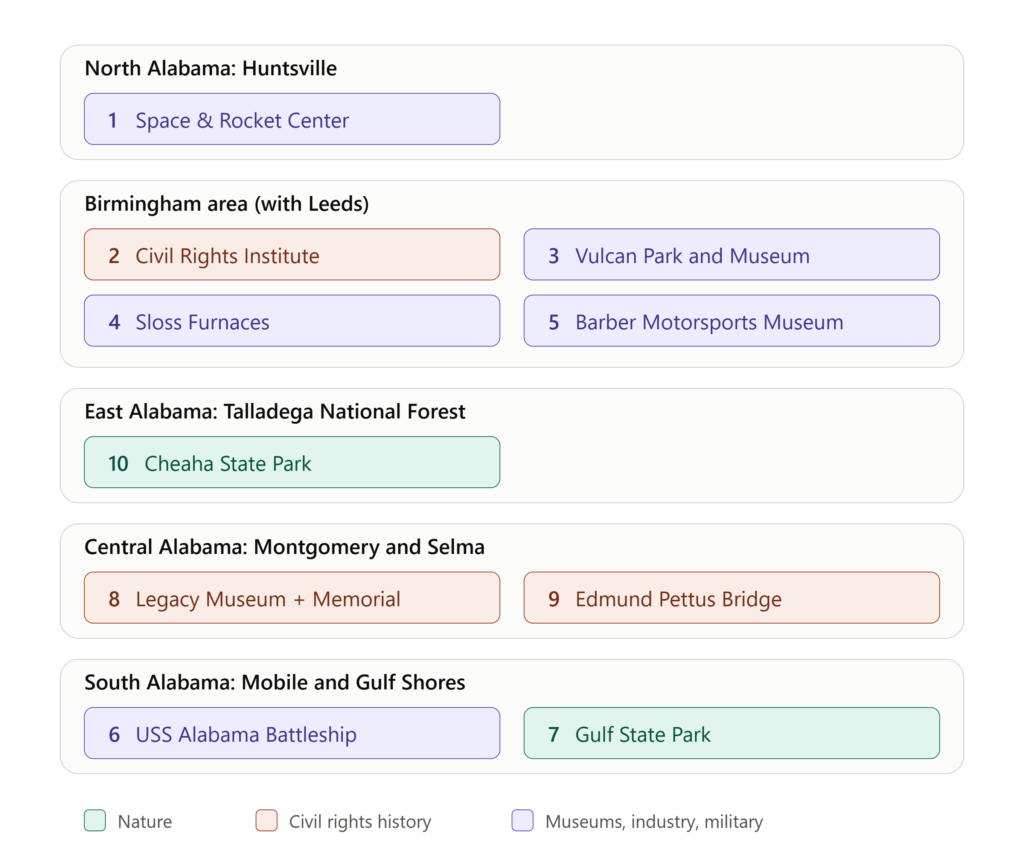
The top 10 attractions in Alabama are the U.S. Space & Rocket Center in Huntsville, USS Alabama Battleship Memorial Park in Mobile, the Birmingham Civil Rights Institute, the Legacy Museum and National Memorial for Peace and Justice in Montgomery, Gulf State Park in Gulf Shores, Cheaha State Park, Vulcan Park and Museum, the Barber Vintage Motorsports Museum, Sloss Furnaces, and the Edmund Pettus Bridge in Selma.
Most “best of Alabama” lists hand you ten names and stop there. Alabama is a long drive from top to bottom, so the order in which you visit matters as much as the list itself. This guide groups each attraction by region, says how much time to budget, and shows which stops pair well on a single trip. Ticket prices and hours change often, so we send you to each official site rather than print numbers that may be out of date.
North Alabama: Huntsville
1. U.S. Space & Rocket Center
Huntsville is where much of America’s rocket work happened, and the U.S. Space & Rocket Center is the place to see it. It is a Smithsonian Affiliate and the official visitor center for NASA’s Marshall Space Flight Center. The headline exhibit is Saturn V Hall, home to a Saturn V Moon rocket that is a National Historic Landmark. Outside, Rocket Park and the Military Park show off space and military hardware, and a model of NASA’s Payload Operations Integration Center shows how scientists on Earth run experiments aboard the International Space Station.
The center is also home to Space Camp, so expect school groups and a hands-on feel. Hours change by season (winter hours have run daily from 10 a.m.), so check the official site before you drive. Plan a half day at minimum if you want the simulators and the planetarium as well as the big rocket.
Central Alabama: Birmingham and Leeds
Birmingham packs four very different attractions into one metro area, which makes it the easiest region to cover in a weekend.
2. Birmingham Civil Rights Institute
The Birmingham Civil Rights Institute opened in 1992 and is a Smithsonian affiliate. It anchors the Civil Rights District and the Birmingham Civil Rights National Monument, which opened as a national park unit in 2023. A local civil rights historian says the galleries alone take two to three hours, and the interactive multimedia exhibits work for all ages.
Make it a full circuit. Kelly Ingram Park, across the street, was the site of the 1963 Children’s March and holds sculptures, signs and the Four Spirits statue honoring the four girls killed in the bombing of 16th Street Baptist Church. The church faces the park. The park is free and open daily, while the museum has been closed Sunday and Monday, so confirm days before you go. Contact the church directly about tours.
3. Vulcan Park and Museum
Vulcan, the Roman god of the forge, stands 56 feet tall over Birmingham. You can climb the tower beside the statue for a view of the city. Birmingham grew up around iron and steel, so Vulcan is less a quirky statue than a symbol of why the city exists. It is a short stop of an hour or two, and it sets up the next two attractions well.
4. Sloss Furnaces
Sloss Furnaces is an immense turn-of-the-20th-century blast furnace, a place to wander among huge rusting structures. Roadside America calls it a destination for anyone who loves industrial ruins, and the description fits. Walk the grounds to understand the scale of the work that built Birmingham, then pair it with Vulcan for a single “Steel City” half day.
5. Barber Vintage Motorsports Museum
In Leeds, just outside Birmingham, the Barber Vintage Motorsports Museum is billed as the world’s largest motorcycle museum, with a collection of nearly 1,400 motorcycles and a few dozen cars. The building has been described as a cross between the Guggenheim and a parking garage, and the display design is as much a draw as the machines. You do not need to ride to enjoy it: the collection spans racing history, engineering and sheer variety. Allow two to three hours.
South Alabama: Mobile and the Gulf Coast
6. USS Alabama Battleship Memorial Park
Docked in Mobile Bay, USS Alabama Battleship Memorial Park houses the World War II battleship USS Alabama, the submarine USS Drum and three other vessels. The park also has more than 30 historic aircraft and military vehicles, including the top-secret Mach 3 A-12 Blackbird spy plane and a North American B-25 Mitchell. Few military attractions in the country put a battleship, a submarine and a Blackbird on the same grounds.
Budget half a day to see the ships and the aircraft.
7. Gulf State Park
Gulf State Park is Alabama’s southernmost state park, on the Gulf of Mexico in Gulf Shores, and it covers roughly 6,000 acres of beach, dunes, a freshwater lake, marsh and pine forest. The Gulf State Park Pier reaches more than a quarter mile into the Gulf. Lake Shelby sits at the center of the park, and the Hugh S. Branyon Backcountry Trail system links trails through six or more habitats, so you can bike or walk well beyond the sand.
The Nature Center explains local wildlife, including the endangered Alabama beach mouse, and The Lodge at Gulf State Park sits on the beach. Sources disagree on exact beach length and trail mileage (figures run from two to more than three and a half miles of beach, and from about 25 to 28 miles of trail), so treat any single number as approximate. The park is a good pairing with Mobile, since both are on the Gulf Coast end of the state.
Central Alabama: Montgomery and Selma
8. Legacy Museum and National Memorial for Peace and Justice
Run by the Equal Justice Initiative in Montgomery, the Legacy Museum and the National Memorial for Peace and Justice are among the most powerful visits in the state. The museum traces American history from the slave trade through Reconstruction, lynching, segregation and modern mass incarceration, using film, sculpture and first-person accounts. It stands on the site of a former warehouse where enslaved people were held.
The memorial is the nation’s first dedicated to the legacy of enslaved Black people and victims of racial terror lynching, and it uses more than 800 steel monuments, one for each county where lynchings occurred. A shuttle links the two sites. Timed tickets are required for the museum, so book ahead. The operator suggests three to five hours for the museum and one to two for the memorial, and no photography is allowed inside the museum. A newer site, Montgomery Square, covers the 1955 to 1965 Montgomery movement.
9. Edmund Pettus Bridge, Selma
Selma is the natural second stop after Montgomery. The Edmund Pettus Bridge is where marchers set out toward Montgomery in 1965, and visitors still walk across it. The route they followed ended near Montgomery Square, which ties the two cities together on a single day trip. Confirm local museum and site hours before you go.
Northeast Alabama: Cheaha
10. Cheaha State Park
Cheaha State Park holds Cheaha Mountain, the highest natural point in Alabama at about 2,400 feet above sea level. It is the oldest continuously operating state park in Alabama, built up in the 1930s by the Civilian Conservation Corps, and it sits inside Talladega National Forest. The name comes from a Creek word for “high place.”
Climb the CCC-built observation tower for a wide view, then take the accessible Doug Ghee Trail to the boardwalk at Bald Rock. The park has a lodge, cabins, a restaurant and camping. Fall is the standout season, with peak leaf color and cooler air in October and November. From Birmingham, take Interstate 20 east and follow the signs toward the park; plan it as a long day trip or an overnight.
How to Combine These Attractions
Treat Alabama as four trips, not one:
- Birmingham weekend: Birmingham Civil Rights Institute and Kelly Ingram Park, Vulcan, Sloss Furnaces, Barber Vintage Motorsports Museum.
- Montgomery and Selma: the Legacy Museum, the National Memorial and the Edmund Pettus Bridge, which can be done as two long days.
- Gulf Coast: USS Alabama in Mobile and Gulf State Park in Gulf Shores.
- Huntsville and Cheaha: the Space & Rocket Center, plus a mountain day when the leaves turn.
FAQ
What is the number one attraction in Alabama?
There is no single official ranking. The U.S. Space & Rocket Center, USS Alabama Battleship Memorial Park and the civil rights sites in Birmingham and Montgomery appear on nearly every major list, so start there.
How many days do you need to see Alabama’s top attractions?
Give each region its own trip. A weekend covers Birmingham, a long weekend covers Montgomery and Selma, and Mobile with Gulf State Park fits another. Huntsville and Cheaha are each worth a full day.
What is the best time of year to visit?
It depends on the stop. Fall suits Cheaha State Park for leaf color, the Gulf Coast is best in the warmer months for beach time, and museums in Birmingham, Montgomery and Huntsville work year-round.
Are Alabama’s civil rights sites free?
Some are. Kelly Ingram Park in Birmingham is free to visit. The Birmingham Civil Rights Institute and the Legacy Museum charge admission, and the Legacy Museum requires timed tickets, so check each official site.
What are the best attractions in Alabama for kids?
The Space & Rocket Center, with its Space Camp connection and simulators, and USS Alabama, where children can explore a battleship and submarine, are the strongest picks. Gulf State Park’s Nature Center and beach also suit families.