
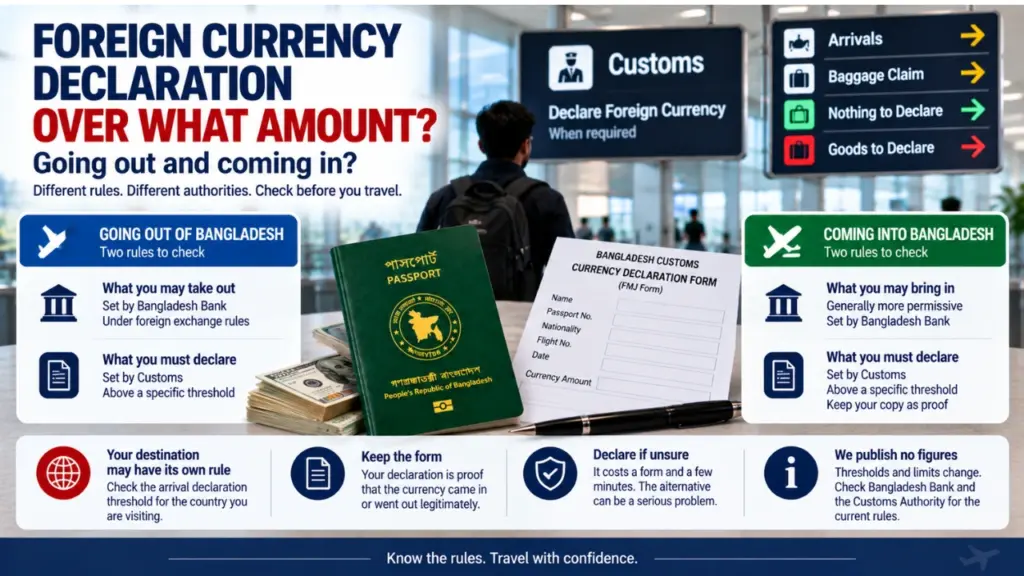
“Over what amount do I have to declare, going out and coming in?”
Two different questions with two different answers, and the form in the middle does a job on the way home that most travelers never realize they will need.
What the form is for
A currency declaration form records how much foreign currency you carried across the border and when.
Its obvious purpose is on the way in or out: telling the authority what you are carrying, above whatever threshold applies.
Its less obvious purpose, and the one that matters most in practice, is evidence. A declaration made on arrival is your proof that the currency you are holding came into the country legitimately. Without it, currency in your possession has no documented origin, and that is a problem you do not want to be solving at a desk.
So the form is not only a compliance obligation. It is a receipt you are giving yourself.
Why this page publishes no threshold
We are not going to give you the amount above which declaration is required.
On 2026-08-28 we attempted to retrieve the current published thresholds from the Bangladeshi customs authority’s own site. Our automated fetch returned a TLS certificate verification failure, meaning our tooling could not establish a trusted connection to read it. Searches restricted to Bangladeshi government domains did not surface the current figures either.
Those are statements about our retrieval on that date, not claims that the authorities publish nothing and not a suggestion that anything is withheld. Bangladesh Bank and the customs authority are the sources for their own rules.
And a reason that stands independently of our tooling: these thresholds move. They are set by regulation and they are revised. A figure published here today can be wrong within months while still looking authoritative, and this is a subject where being wrong by a small margin has consequences out of proportion to the error.
A page that explains the mechanism and sends you to the authority is worth more than one that gives you last year’s number.
The four separate rules people run together
This is where most confusion on this subject comes from, and separating them is most of the value here.
1. What you may take out of Bangladesh. A limit set under the foreign exchange rules, generally tied to your travel and to the quota system.
2. What you must declare on the way out. A threshold, above which the declaration is required.
3. What you may bring in. Generally more permissive than what you may take out.
4. What you must declare on the way in. A separate threshold, and this is the one that produces the receipt described above.
Those are four numbers, not one, and a page quoting “the limit” is describing one of them at best. Two of them are Bangladesh Bank’s territory and two are the customs authority’s, which is why looking in one place gives you half the answer.
And a fifth, which is not Bangladesh’s at all: the destination’s own declaration threshold on arrival, which is set by that country and is frequently different. Complying with the Bangladeshi rule says nothing about complying with theirs.
What to do, practically
Read Bangladesh Bank’s current guidance on what you may carry, and the customs authority’s current guidance on what must be declared. Both, not one.
Read your destination’s arrival declaration threshold on their customs authority’s page.
Declare if you are near the line rather than under it. Declaring costs you a form and a few minutes. The alternative, if you have misjudged it, is not proportionate.
Keep your copy of the form. This is the step people skip and regret. A declaration you cannot produce is a declaration that is difficult to rely on later.
Keep your exchange receipts as well, because they document where the currency came from.
Count what you are actually carrying, including what is in a second bag or held by a traveling companion. Currency carried by a family group is a scenario with its own treatment, and assuming that splitting an amount between two people solves a threshold problem is an assumption worth checking rather than making.
Cards are not a way around this
Electronic money moves under a different set of rules, not under no rules.
Card usage abroad, endorsement against your passport, and the quota system are their own subject on this site, and they are governed by Bangladesh Bank rather than by customs.
What is worth saying here is that “I will just take a card” does not remove you from a regulatory system, it moves you into a different part of it, and that part has its own requirements about endorsement and limits.
Coming home with currency you did not spend
This is the case where the outbound declaration earns its keep.
Currency you took out, did not spend, and are bringing back is documented by the form you filled on the way out. Without it, the same notes are simply foreign currency in your possession.
The same applies to money given to you abroad, earned abroad, or exchanged abroad. The question the authority is answering is where it came from, and a piece of paper answers it faster than anything you can say.
Where this sits in a trip
Currency handling is one of the last things travelers plan and one of the first things that goes wrong, because it involves two regulators, a bank, and a threshold nobody has checked.
If this is your first trip, the whole sequence in order is in your first international trip from Bangladesh, and the money step belongs earlier in it than most people put it.
And if your destination requires no visa, that changes the cost of the trip and therefore what you need to carry, which is covered in visa-free countries on a Bangladeshi passport.
The physical goods side of the same customs desk, the phones and gold questions, is a separate subject with its own page on this site.
What we will not do
Publish a threshold or a limit we could not verify. Not as a range and not with a caveat.
Tell you how to carry currency without declaring it. That is not information and this site does not provide it.
Tell you whether splitting an amount between travelers works. That is precisely the question to ask the authority rather than a website, and the wrong answer has consequences.
Recommend a bank, an exchange house or a facilitator.
FAQ
What is the FMJ form?
A currency declaration form used at Bangladeshi customs to record foreign currency carried across the border. It serves both as the declaration and, importantly, as your own evidence of where currency you hold came from.
How much foreign currency can I carry out of Bangladesh?
This page publishes no figure. Our retrieval of the current published limits failed on 2026-08-28 with a TLS certificate verification error on a government site. Bangladesh Bank sets what may be carried and the customs authority sets what must be declared, and both are the sources for their own rules.
Is the declaration threshold the same going out and coming in?
No. They are separate rules with separate thresholds, and they are frequently quoted as though they were one.
Do I need to keep the form?
Yes, and it is the step people skip. The copy is what documents that currency you are holding came in or went out legitimately, and a declaration you cannot produce is hard to rely on.
Does my destination have its own declaration rule?
Almost certainly, set by that country and frequently different from Bangladesh’s. Complying with one says nothing about the other.
Retrieval note, recorded rather than hidden: on 2026-08-28 an automated fetch of the Bangladeshi customs authority’s site returned a TLS certificate verification failure, and searches restricted to Bangladeshi government domains did not surface the current published currency declaration thresholds. Our tooling failed to reach the material. That says nothing about the publishers, and Bangladesh Bank and the customs authority remain the sources for their own rules.
This page publishes no declaration threshold, currency limit or quota figure. These are set by regulation and revised, and a stale figure here would have consequences out of proportion to the error.
General information, not legal, tax or foreign exchange advice. Verify current limits and thresholds with Bangladesh Bank and the Bangladeshi customs authority, and your destination’s threshold with their own customs authority, before you travel.