
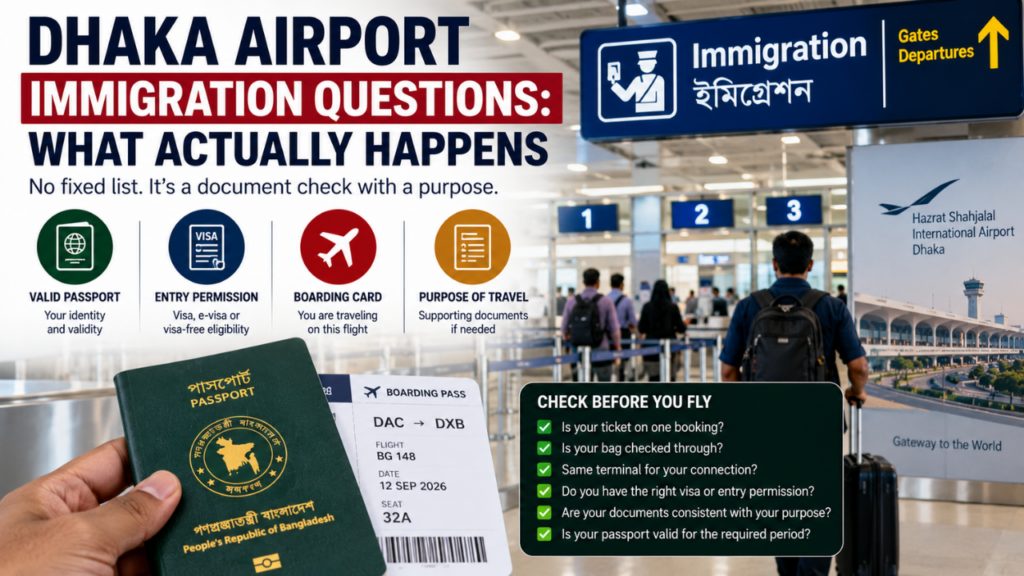
There is no published list of Dhaka airport immigration questions, and any page that gives you one is guessing. Departure immigration is a document check with a person attached: an officer confirms that your passport is valid and yours, that you hold the entry permission your destination requires, and that your papers are consistent with the reason you give for traveling. Officers ask whatever they judge necessary in front of them. The part you can control is the documents, not the script.
That is the honest answer, and the rest of this page is the useful part: what the check is actually for, which documents establish which thing, and where problems genuinely come from.
Why nobody publishes the questions
Immigration officers exercise judgment. That is the job. A departure check is not a form with fixed fields, so no authority publishes a script, and a website that prints “they will ask you these seven questions” has either invented them or copied someone who did.
We are not going to add to that. Nobody at this site has stood at that counter, and a reconstructed conversation with an officer would be a fabrication dressed as experience. What follows instead is drawn from what the airport publishes about the step, and from the document requirements that airlines and destination authorities publish themselves.
The airport’s own departure guideline, read on 8 September 2026, describes the step in a single sentence: complete immigration formalities by presenting your passport, boarding card and required documents, and make sure your passport receives the official seal. Departure immigration sits on the departure floor near the check-in rows, signposted Immigration-1, 2 and 3, and you reach it after check-in and before security screening. The order does not change by destination.
What the check is actually establishing
Four separate things, and it helps to see them as four rather than one.
| What is being established | What establishes it | Who issues it |
|---|---|---|
| The passport is valid and is yours | A valid Bangladeshi passport, matching your face and your other papers | Department of Immigration and Passports |
| You are permitted to enter your destination | A visa, an e-visa, an approved travel authorization, or documented visa-free eligibility | The destination country’s authority |
| You are actually traveling on this flight | The boarding card issued at check-in | Your airline |
| Your stated purpose is supported | Whatever documents that purpose normally comes with | Varies by purpose |
Only the last row is open-ended, and that is where the anxiety in this query lives. There is no universal document that proves a purpose. What exists is a normal set of papers for each kind of trip, and carrying them is the whole of the preparation.
The documents that support a stated purpose
If you are traveling as a tourist, the papers that normally accompany that are the visa or authorization itself, the return or onward ticket, and the accommodation booking. If you are traveling to visit family, the invitation and the host’s details usually accompany it. If you are traveling for a conference, an admission or a course, the paperwork that got you the visa is the paperwork that supports the trip.
The pattern is simple. The documents that supported your visa application are the documents that support your departure. Keep them together, keep them accessible rather than in a checked bag, and keep a copy on your phone. If you were refused a visa before and reapplied successfully, it is worth understanding why applications get refused, because the same inconsistencies that lose an application are the ones that create questions later.
Some passengers have an extra, documented requirement rather than a judgment call. The airport’s guide names the Prabashi Kalyan Desk for Bangladesh-to-Saudi Arabia travelers: passengers traveling on leave have a leave certificate verified before check-in, and first-time passengers have a BMET card verified and sealed at the desk inside the immigration area after check-in. That is a published requirement with a specific desk, not a question.
A police clearance certificate is a document many travelers assume is part of this and it usually is not. It belongs to particular visa categories rather than to the departure check itself, and we have set out when a traveler actually needs a police clearance certificate separately.
Where problems actually come from
In our reading of the published requirements, the failure modes that are within a traveler’s control are almost all document problems rather than answer problems.
The first is a mismatch. If your name is spelled one way on your passport and another way on your ticket, or your date of birth differs between your passport and your national ID, that is a discrepancy an officer has to resolve rather than ignore. It is also not fixable at the airport. Our guide to a passport name or date of birth mismatch covers the correction route, and the timeline is measured in weeks.
The second is validity. Many destinations require a passport valid for a set period beyond your arrival date, and the airline is usually the party that enforces it at check-in. If your book is close to expiry, deal with it before you book, not after.
The third is entry permission that is not what you think it is. An approved e-visa, a visa on arrival that requires conditions to be met before boarding, and visa-free entry that carries a time limit are three different things with three different proofs. Check the destination authority’s own page rather than a summary.
The fourth is the passport itself. If you hold a Bangladeshi e-passport you may be routed to an automated gate instead of a staffed counter, which changes the queue but not the requirements. Eligibility is narrower than most people expect, and we have written it up in who can and cannot use the e-gate at Dhaka airport.
If you are asked to step aside
It happens, and it is not by itself a refusal. An officer may refer a passenger to a supervisor or to a secondary check for reasons that are theirs to weigh.
We are not going to tell you what to say, because nobody at this site is qualified to and because coaching a traveler on how to present themselves to an immigration officer is exactly the kind of advice that gets people into trouble rather than out of it. The general position is uncontroversial: answer truthfully, produce the documents you were asked to produce, and if the outcome is a refusal to depart, ask what the reason is and who to approach about it.
If a departure decision has real consequences for you, the correct route is the Department of Immigration and Passports and, where a destination’s entry permission is the issue, that country’s mission in Dhaka. Nothing on this page is legal advice, and it is not a substitute for either.
What we will not publish here
No list of questions. No timings. No account of an officer’s manner, no “they tend to focus on”, no description of which counter moves faster, and no story about a departure any of us did not make. Those are the details this query rewards and they are also the details that cannot be sourced, which is precisely why the pages that carry them should be read carefully.
What we will keep current is the document side, because that is published, checkable and stable. If this is your first departure, the full preparation sequence is in our first international trip from Bangladesh checklist.
Source read for this page on 8 September 2026: the Hazrat Shahjalal International Airport passenger guide, departure guideline (hsia.gov.bd). Entry requirements must be confirmed with the destination country’s own authority, and passport matters with the Department of Immigration and Passports.
FAQ
Does Dhaka immigration ask departing Bangladeshis about their job or income?
No authority publishes what officers ask, and we are not going to invent it. The check is about identity, entry permission for the destination, and documents consistent with the stated purpose of travel. Carry the papers that supported your visa application.
What documents should I keep in my hand at departure immigration?
Your passport and the boarding card issued at check-in, plus the entry permission for your destination and the supporting papers for your trip. Keep them out of your checked bag.
Can immigration stop a Bangladeshi citizen from leaving the country?
A departure decision rests with the immigration authority and can be affected by matters outside travel documents entirely, including legal restrictions on an individual. If this may apply to you, get proper advice from the Department of Immigration and Passports or a lawyer before you book, not at the airport.
Is a return ticket required to leave Bangladesh?
Onward or return ticket requirements are usually imposed by the destination country and enforced by the airline at check-in rather than by Bangladeshi departure immigration. Check the destination authority’s own entry rules and your airline’s conditions of carriage.
Do I use the e-gate or a counter on the way out?
That depends on your passport type and on eligibility rules that are narrower than most travelers assume. Plan for a staffed counter and treat an automated gate as a bonus.