
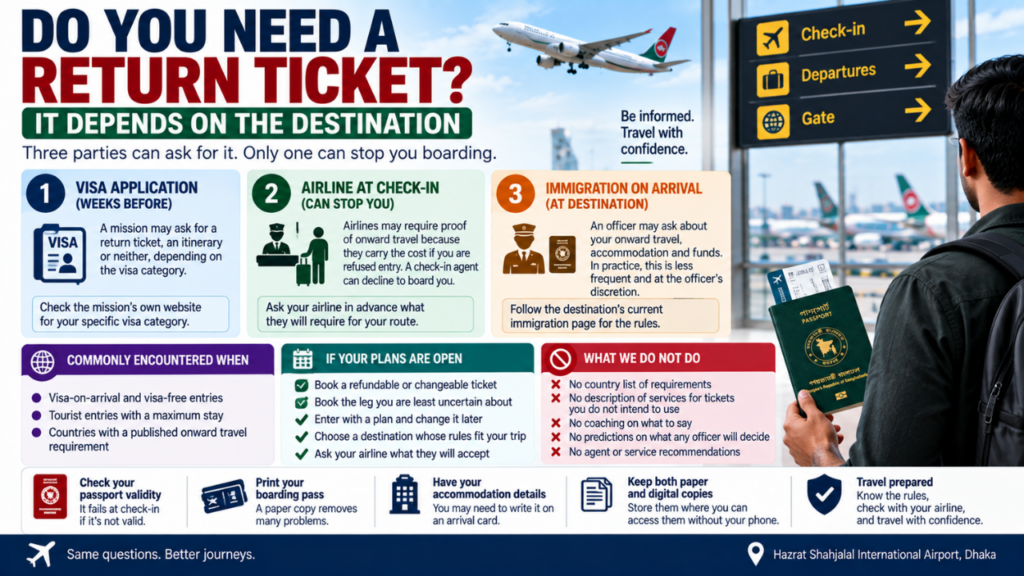
“Do I really need a return ticket booked before I fly?”
Three different parties can ask you for one, at three different moments, for three different reasons. Only one of them can stop you boarding. Separating them is the whole article.
The three checkpoints
1. The visa application, weeks before
A mission processing a visa application asks for what its own published document list says.
Some categories ask for a booking, some ask for an itinerary, some ask for neither. The list on the mission’s own page for your specific visa category is the authority, and every other list is a summary of a version of it.
What the mission is assessing here is whether you are a genuine visitor with a planned, funded trip. This site explains what is assessed and stops there, because coaching an application is what agencies sell and it cannot be sourced.
2. The airline, at check-in
This is the one that can actually stop you, and it is the one nobody expects.
Airlines are exposed to penalties for carrying a passenger who is refused entry at the destination, and they are the party who has to fly that person back. So airlines apply the destination’s entry requirements at check-in as a commercial risk decision.
Which means a check-in agent may decline to board you for a document the immigration officer would never have asked about. That is not the agent being difficult. It is the airline managing a liability it carries and you do not.
And it is why “immigration never asks” is not a useful basis for planning. The person who asks is at the desk in Dhaka, hours earlier.
3. Immigration, on arrival
An officer at the destination may ask about your onward travel, your accommodation and your funds, as part of deciding whether to admit you.
In practice this is less frequently a document check than the first two, and it is entirely at the officer’s discretion.
Which destinations actually require it
We are not going to give you a list, and the reason is that the requirement is per country, per visa category, and it changes.
Where it is most commonly encountered:
Visa-on-arrival and visa-free entries, because the destination has no application process in which to assess you, so the assessment moves to the border and to the airline. Which destinations require no visa for a Bangladeshi passport is in visa-free countries on a Bangladeshi passport, and it is precisely those where the onward-ticket question arises most.
Tourist entries with a defined maximum stay.
Countries with a published requirement for proof of onward travel, which some state explicitly on their immigration pages.
Read the destination’s own current immigration page, and if you want certainty about the airline’s behavior, ask your airline directly whether they will require proof at check-in for your route. They will tell you, and asking a week beforehand costs nothing.
What we are not going to describe
There is an industry built around producing a ticket you do not intend to use.
This site does not describe those services, does not name them, does not explain how they work and does not recommend them.
The reason is not squeamishness. It is that the requirement exists because a country wants evidence that you are leaving, and this site’s rule is that it explains what a decision maker is assessing and never coaches a reader on how to satisfy it. A page that walks you through producing evidence for an assessment is on the wrong side of that line, and on an immigration topic being on the wrong side of it costs the reader more than it costs us.
If you need to satisfy an onward-travel requirement, the way to do it is to have onward travel.
The legitimate options when your plans are genuinely open
Some travelers really do not know their exit date, and that is not a problem to be solved with a trick.
Book a refundable or changeable ticket. It costs more and it is a real ticket.
Book the leg you are least uncertain about, even if the rest is open.
Enter with a plan and change it. A ticket you booked and then changed is not a false document.
Choose a destination whose rules fit your trip. Requirements differ, and it is a legitimate input into where you go.
Ask the airline what they will accept for your route. A confirmed onward booking, an overland exit and a bus or train reservation are treated differently by different carriers, and the answer to that is available in advance for the cost of a phone call.
The accommodation half
The same three-checkpoint structure applies, and the same rule about who can stop you.
A mission may ask for an accommodation booking as part of a document list. An airline is much less likely to check this than an onward ticket. An immigration officer may ask where you are staying.
A booking you have made and can produce is the straightforward answer, and where your plans are genuinely open, a refundable first-night booking is a real booking rather than a device.
The practical preparation
Carry your documents in a form you can produce at a desk, on paper and on a phone, because a check-in hall is a poor place to be searching an email account on a weak connection.
Carry the destination’s own published requirement if you expect it to be a conversation, because a printout of the immigration authority’s page is a more useful thing to have at a check-in desk than an argument.
Check your passport validity, because a document that fails there fails before any of this matters.
If this is your first trip, the whole sequence and where each document belongs in it is in your first international trip from Bangladesh.
What we will not do
Tell you whether you need one for a named destination. That is the destination’s rule, it changes, and their own page is the source.
Describe, name or recommend any service that produces a ticket you do not intend to use.
Coach you on what to say at a check-in desk or a border.
Tell you what any officer will decide.
FAQ
Do I need a return ticket to travel on a Bangladeshi passport?
It depends on the destination and the visa category, and it is most commonly encountered on visa-free and visa-on-arrival entries where the assessment happens at the border rather than in an application.
Who actually checks for an onward ticket?
Three parties can: the mission during a visa application, the airline at check-in, and immigration on arrival. The airline is the one most likely to stop you, because it carries the liability for a refused passenger.
Why does the airline care if immigration does not?
Airlines face penalties for carrying passengers who are refused entry, and they have to fly them back. So they apply the destination’s requirements as a commercial risk decision at check-in.
What if my plans are genuinely open?
Book a refundable or changeable ticket, or the leg you are least uncertain about. A real ticket you later change is a real ticket. This page describes no alternative to that.
Is a hotel booking checked as often as an onward ticket?
Generally less often by airlines, more often by missions as part of a document list, and sometimes by an immigration officer as a question. A refundable first-night booking is a straightforward answer where plans are open.
This page publishes no country list, no requirement table and no service recommendation. Requirements are set per destination and per visa category and they change; the destination’s own immigration authority and the mission accredited to Bangladesh are the sources, and your airline is the source for what it will accept at check-in on your route.
General information, not immigration advice. It does not coach any reader on satisfying any requirement, describes no method of producing a ticket that is not intended to be used, and recommends no agent or service.