
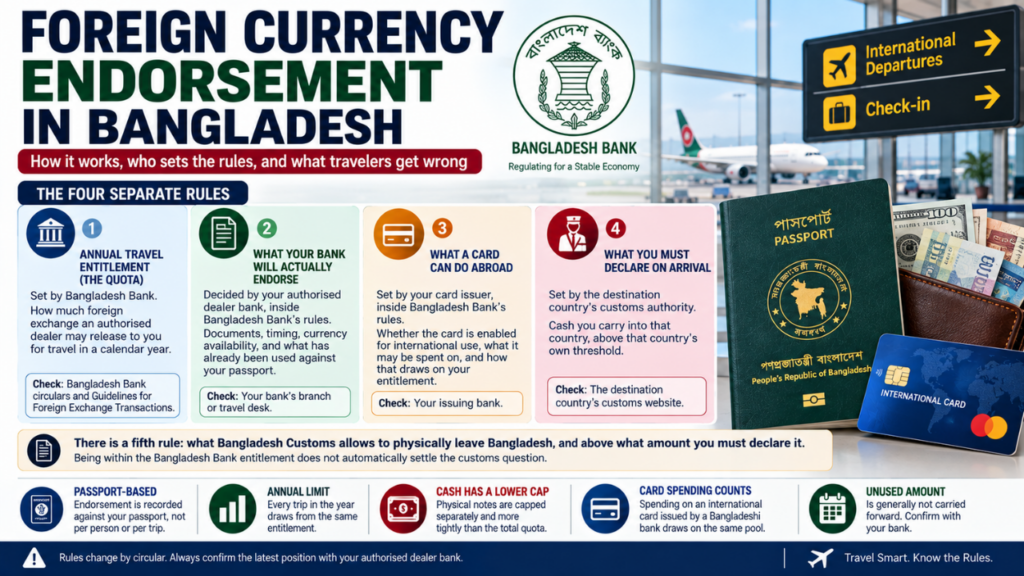
Foreign currency endorsement in Bangladesh is a record written against your passport. An authorised dealer bank or licensed money changer releases foreign exchange to you for travel and marks it against that passport, so the amount you have taken in a calendar year can be checked before more is released. Bangladesh Bank sets the entitlement and Bangladesh Customs governs what physically leaves the country. Those are two different rules, and there are two more behind them.
This page separates the four rules travelers merge into one, explains the mechanism of endorsement, and tells you plainly which figures we were able to confirm from an issuing authority on 8 September 2026 and which we were not. Nothing here is financial or legal advice, and none of it replaces your own bank.
The four rules travelers merge into one
| The rule | Who sets it | What it governs | Where to check it |
|---|---|---|---|
| The annual travel entitlement, commonly called the quota | Bangladesh Bank | How much foreign exchange an authorised dealer may release to you for travel in a calendar year | Bangladesh Bank circulars and the Guidelines for Foreign Exchange Transactions |
| What your bank will actually endorse | Your authorised dealer bank, inside Bangladesh Bank’s rules | Documents, timing, currency availability, and what has already been used against your passport | Your own bank’s branch or travel desk |
| What a card can do abroad | Your card issuer, inside Bangladesh Bank’s rules | Whether the card is enabled for international use, what it may be spent on, and how that draws on your entitlement | Your issuing bank |
| What you must declare on arrival | The destination country’s customs authority | Cash you carry into that country, above that country’s own threshold | The destination country’s customs website |
There is a fifth rule sitting between the first and the last: what Bangladesh Customs allows to physically leave Bangladesh, and above what amount you must declare it. Travelers routinely assume that being within the Bangladesh Bank entitlement automatically settles the customs question in both directions. It does not.
What endorsement actually is
Endorsement is a marking made against your own Bangladeshi passport by the institution releasing the currency. In practice it records who released the foreign exchange, how much, in what form, and against which passport, so that the same passport cannot quietly draw the same annual entitlement several times over at several institutions.
That is why the passport is the unit of account rather than the person or the trip. It is also why a new passport is not a reset button. If your book is close to expiry, our guide to e-passport renewal timing is worth reading before you plan any endorsement around it, and the question of how a renewal affects an existing endorsement record is one for your bank rather than for us.
Bangladesh Bank operates central monitoring systems that authorised dealers use to see what has already been released and spent against a passport before releasing more. The practical consequence for a traveler is simple: the bank is not taking your word for how much of the year you have used.
The entitlement, and what we will and will not state as a figure
Bangladesh Bank’s Guidelines for Foreign Exchange Transactions, Volume 1, contains a chapter titled “Travel” that is the standing rulebook here, and the bank amends it by circular. On 8 September 2026 we read Bangladesh Bank’s own circular index at bb.org.bd and it lists FEPD-1 Circular No. 33, dated 6 September 2026, subject “Release of foreign exchange for travel abroad.”
We could not open that circular’s text. The file is published as a PDF that did not render as readable text for us, so we have not seen the operative wording with our own eyes. National newspapers reported in the days after it that the annual travel entitlement was raised, and we are not repeating their figure here. A legal ceiling on money you are allowed to carry is exactly the kind of number that should come from the institution that set it, and an unsourced figure with a caveat attached is still an unsourced figure.
What we can tell you is more useful than a number anyway. The entitlement changed in early September 2026. Any page you read about the Bangladesh travel quota that was written before that date, including pages that look official, is describing the previous position. Ask your authorised dealer bank what the current entitlement is, and ask them to tell you which circular they are applying.
The structural features of the entitlement have been stable across successive circulars and are what you actually plan around: it is an annual amount counted on a calendar year, it is held against your passport, minors are entitled to a reduced proportion of the adult amount, and the release of physical dollar notes is capped separately and at a lower level than the entitlement as a whole.
What Bangladesh Customs publishes about carrying currency out
This is where a second government source comes in, and where the two do not currently agree.
Bangladesh Customs, under the National Board of Revenue, publishes a currency regulations page for passengers. Read on 8 September 2026, that page states that an adult passenger may take out up to US$12,000 annually, made up of US$5,000 for travel to SAARC countries and Myanmar and US$7,000 for other destinations, with minors entitled to half those amounts, and that currency carried as cash is limited to US$5,000 per trip. The page cites FE Circular No. 17 of 6 April 2014 and FE Circular No. 02 of 11 February 2015 as its authority.
The same page states that an incoming passenger may bring in any amount of foreign currency provided amounts above US$5,000 are declared on Form FMJ, and that a passenger may carry Tk 5,000 in Bangladeshi currency in or out without declaring it, citing FE Circular No. 05 of 30 January 2014.
Two warnings go with those figures, and they matter more than the figures.
First, the customs page is citing circulars from 2014 and 2015 and does not reflect Bangladesh Bank’s September 2026 travel circular. Read the customs figures as the older published position, not as today’s entitlement.
Second, the airport’s own passenger FAQ also restates a currency figure, and on 8 September 2026 it carried the older one too. Three Bangladeshi government-facing pages describing the same rule do not currently say the same thing. That is not a scandal, it is how a rule that moves by circular propagates through websites, and it is the single best reason to confirm your own position with your bank in the week you travel rather than with any website, this one included.
What your bank will actually endorse
The entitlement is a ceiling. What you get is a bank decision inside that ceiling.
Authorised dealer banks work from your passport and your travel documents. Guidance in Bangladesh Bank’s framework requires dealers to retain copies of the relevant passport pages, including the page carrying the visa where there is one and the page recording the endorsement, together with the pages of the ticket showing the passenger name, route and date of journey. Your bank will tell you its own document list, and it may differ in detail between banks.
Three things are worth knowing before you go in.
The bank checks your history first. Before releasing fresh currency the dealer verifies what has already been drawn against that passport through Bangladesh Bank’s monitoring systems for wire transfers, international cards and money changers. If a previous trip drew on the same year, that shows.
Availability is not the same as entitlement. Whether a branch can hand you a particular currency in cash on a particular day is a treasury matter at that bank, not a legal one.
Some categories are treated separately. Bangladesh Bank issues distinct circulars for purposes such as study abroad through international cards and for visa bonds or refundable security deposits, both of which appeared in its 2025 and 2026 circular index. If your trip is not straightforward personal travel, that is a conversation with your bank rather than an inference from a travel page.
If you are assembling a first trip end to end, this piece sits alongside our first international trip from Bangladesh checklist, and the separate government charge on international departures is covered in who pays Bangladesh travel tax and how it is collected.
Cards abroad, and why they are not a way around anything
An international card issued by a Bangladeshi bank draws on the same entitlement. That is the point most often missed. A card is a different form of the same allowance, not an additional allowance, and card spending abroad is visible to your bank and to Bangladesh Bank through the card monitoring system.
What a card actually does for you is remove the need to carry notes, which matters given that the cash component is separately capped. What it does not do is enlarge what you are entitled to spend, and what it may not do is work everywhere: international usage on a Bangladeshi card typically has to be enabled, may be limited by merchant category, and can be declined abroad for reasons that have nothing to do with your balance. Ask your issuer what is enabled on your card, in which countries, and for which types of transaction, before you rely on it.
The destination country’s rule is not Bangladesh’s
The last of the four rules belongs to somebody else entirely. Most countries require arriving passengers to declare cash above a threshold set in that country’s own law, and that threshold has nothing to do with Bangladesh’s.
The two are independent. You can be entirely within Bangladesh’s outbound rules and still be required to fill in a declaration when you land, and failing to do so is the destination country’s offense, not Bangladesh’s. Some visa routes also require evidence of funds at application stage, which is a third thing again: a Schengen visa application from Bangladesh has its own financial documentation requirements, and several regional destinations including Thailand have at times published proof-of-funds expectations for arriving visitors. Check the destination authority’s own page for both the declaration threshold and any proof-of-funds requirement.
What we will not publish, and what we will not tell you to do
We are not publishing the current travel entitlement figure, because we could not read it at source on the day of writing. We are not publishing a travel tax figure on this page for the same class of reason. We will publish both the day they can be read on the issuing authority’s own page.
We are also not going to tell you how to move money. There is no section here on carrying more than you are entitled to, no discussion of unofficial channels, and no workaround of any kind, because those routes are illegal, they are enforced against travelers rather than against the people selling them, and describing them would be the opposite of useful.
If your situation does not fit the ordinary personal-travel case, take it to your authorised dealer bank first and to Bangladesh Bank second. Those two can tell you what applies to you. A website cannot.
Where to check, in order
- Your authorised dealer bank. Ask for the current entitlement and the circular they are applying, before you buy tickets.
- Bangladesh Bank, bb.org.bd, for the Guidelines for Foreign Exchange Transactions and the Foreign Exchange Policy Department circular index.
- Bangladesh Customs, under the National Board of Revenue, for what may physically leave and enter Bangladesh and for Form FMJ.
- The destination country’s customs authority, for what you must declare on arrival.
Sources read for this page on 8 September 2026: the Bangladesh Bank circular index at bb.org.bd, including FEPD-1 Circular No. 33 of 6 September 2026; the Bangladesh Bank Guidelines for Foreign Exchange Transactions, Volume 1, travel chapter; the Bangladesh Customs currency regulations page for passengers; and the Hazrat Shahjalal International Airport passenger FAQ. This page carries a 90-day review interval and the rules it describes are revised by circular, so confirm your own position before you travel.
FAQ
What does foreign currency endorsement mean in Bangladesh?
It is a record made against your Bangladeshi passport when an authorised dealer bank or licensed money changer releases foreign exchange to you for travel. It identifies the institution, the amount and the form, so the annual entitlement drawn against that passport can be verified before more is released.
How much foreign currency can I take out of Bangladesh?
Bangladesh Bank sets the annual entitlement and revised it by circular on 6 September 2026. We were unable to read that circular’s text at source, so we publish no current figure. Bangladesh Customs’ passenger page, read 8 September 2026, still shows the older position of US$12,000 a year, split US$5,000 for SAARC destinations and Myanmar and US$7,000 elsewhere, with cash limited to US$5,000 per trip, citing 2014 and 2015 circulars. Confirm the current entitlement with your authorised dealer bank.
Does spending on my card use up the same quota?
Yes. An international card issued by a Bangladeshi bank draws on the same entitlement rather than adding to it, and card spending abroad is visible to your bank through Bangladesh Bank’s card monitoring system.
Do I have to declare the currency when I arrive in another country?
That depends entirely on the destination country’s own threshold, which is set in its law and is unrelated to Bangladesh’s rules. Check the destination’s customs authority before you fly.
Does a new passport give me a fresh quota?
Not necessarily. The entitlement is annual and is recorded against your passport, and how a renewal interacts with an existing record is a question for your authorised dealer bank and Bangladesh Bank, not for a website.