
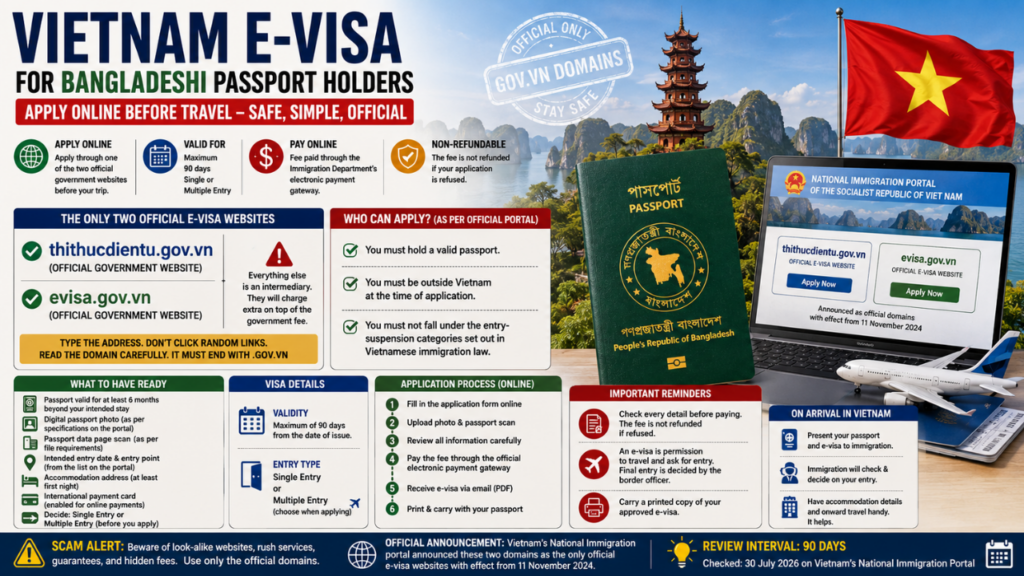
There are exactly two official Vietnamese e-visa websites: thithucdientu.gov.vn and evisa.gov.vn. Vietnam’s National Immigration portal announced both as its official domains with effect from 11 November 2024, and everything else offering to obtain your Vietnamese e-visa is an intermediary. A Bangladeshi passport holder applies online through one of those two before travel. The e-visa is valid for a maximum of 90 days, single or multiple entry. The fee is charged through the Immigration Department’s electronic payment gateway at the rate the Department prescribes, and it is not refunded if your application is refused. All of this was read on Vietnam’s National Immigration portal on 30 July 2026.
If you only take one thing from this page, take the two domain names. The rest of this guide explains why they matter more here than on any other visa in this cluster.
Why this search is full of look-alikes
Run a search for a Vietnamese e-visa from Bangladesh and count how many of the results are governments. The answer is close to none.
The results are dominated by domains built to be mistaken for an authority. Several use constructions like vietnam-visa, vietnam-evisa and vietnam-immigration, at least one of them under a .org.vn suffix that reads, to most people, as Vietnamese and semi-official. They are professionally designed, they rank above the government, and some of them are perfectly functional businesses that will file your application and charge you for it.
The problem is not that intermediaries exist. It is that on this particular visa the government’s own fee is not advertised as a headline number, so a reseller can present a total that includes a substantial markup and nothing on the page tells you which part is theirs. A traveler who does not know the government’s own domain cannot tell the difference between paying a fee and paying a fee plus a commission.
That is why the map for this site treats this row as a portal-verification question rather than a requirements question. The requirements are easy. Knowing where you are is the hard part.
How to check you are on the real portal
Four checks, in order of usefulness:
1. Read the domain, not the design. The address must end in thithucdientu.gov.vn or evisa.gov.vn. Not “contains”, not “starts with”. Ends with. A site at evisa-gov-vn.com or vietnam-evisa.org is not either of those, however similar it looks.
2. Type the address rather than clicking a result. This defeats almost every look-alike at once, because the whole business model depends on being clicked from search or an advertisement.
3. Distrust urgency and upsells. The Immigration Department does not sell you rush processing, priority handling, or a guarantee of approval. A page offering those is a commercial service.
4. Check where the money is going before you enter a passport number. The government’s own payment step routes through the Immigration Department’s electronic payment gateway. A checkout that reads like a normal e-commerce cart with a service fee line is telling you something.
This habit transfers. Every e-visa on this site has the same shape of risk, and the same check works on all of them.
What the e-visa gives you
From Vietnam’s National Immigration portal, read 30 July 2026:
- Validity: a maximum of 90 days.
- Single or multiple entry, chosen when you apply.
Both of those are unusually good for a Bangladeshi passport. Ninety days is longer than most of the region’s short-stay options, and a genuine multiple entry choice at the application stage is rarer still. If your trip involves leaving Vietnam and returning, this is one of the few destinations in this cluster where you can simply select that instead of applying twice.
Two cautions attach to the numbers, and they are the same two that attach everywhere.
The visa’s validity is a maximum, not an entitlement. What you are granted is what your application is approved for, and what you may do at the border is what the border officer permits. A 90 day ceiling does not mean 90 days is issued by default.
Pick your entry type before you pay, not after. Changing your mind later means a new application, and the money already spent does not come back.
Who can apply, in the authority’s own terms
The portal sets out the conditions in a way worth reading literally, because two of them catch people out.
- You must hold a valid passport. Vietnam’s e-visa system also expects a passport with sufficient remaining validity and blank pages, so check both before you start.
- You must be outside Vietnam at the time you apply. The e-visa is an entry authorization, not an in-country extension mechanism.
- You must not fall under the entry-suspension categories set out in Vietnamese immigration law. This is the clause nobody reads. It exists, it is the authority’s own language, and it is a reminder that eligibility is decided under Vietnamese law rather than by the completeness of your form.
Nothing there is exotic for an ordinary tourist trip. It is worth knowing that the conditions are legal conditions, though, because it explains why no site can promise you an approval.
The fee, the gateway, and the refund rule that catches people
This is the most expensive paragraph on the page.
The portal states that the e-visa fee is paid through an electronic payment gateway at the rate prescribed by the Immigration Department, and that the fee will not be refunded if the application is refused.
Read that again. You pay first. The decision comes after. If the answer is no, the money is gone.
That single rule should change how you fill in the form. It means:
- Accuracy is not politeness, it is money. Check every field against your passport, character by character, before you pay. A name spelled differently from the passport, a passport number with a transposed digit, a date entered in the wrong format: any of these can produce a refusal, and each one costs you the fee.
- Do not apply speculatively. Applying “to see if it comes through” while you decide whether to travel is paying for the possibility of a refusal.
- Do not apply through a third party who is prepared to submit an application you have not checked. If it is refused, they keep their commission and the government keeps its fee. You are the only party who loses.
You will notice this guide quotes no amount. The reason is that the authority’s own portal does not publish a headline figure on its landing page: the amount is what the Department prescribes and what the gateway charges at the moment you pay. The US dollar figures that reseller sites present as “the Vietnam e-visa fee” are their prices, not necessarily the government’s. Read the amount at the payment step on thithucdientu.gov.vn or evisa.gov.vn. If a service quotes you meaningfully more, the gap is their margin, and now you know to look for it.
What to have ready before you start
Assemble everything first, then open the form. This is not a process to improvise halfway through, given that the payment is non-refundable.
- Your passport, with comfortable remaining validity beyond your intended departure and blank pages available.
- A digital photograph and a passport data page scan, made to the file specifications the portal states. Read the dimensions and file size limits on the page and match them exactly.
- Your intended entry date and entry point. Vietnam’s e-visa is accepted at a defined set of air, land and sea entry points, so confirm on the portal that the one you plan to use is on the current list.
- Your accommodation address for at least the first night.
- A card enabled for international online payment. Confirm with your bank first. A card declined at the payment step is the most common way an otherwise complete application stalls.
- Your entry type decision, single or multiple, made before you begin.
On arrival
Carry a printed copy of the approved e-visa alongside the digital one. The airline at Dhaka will want to see that you hold a valid authorization before issuing a boarding pass, because carriers bear the cost of a passenger refused entry. Vietnamese immigration then checks the e-visa against your passport and your stated purpose.
As everywhere, an approved e-visa is permission to travel and to ask for entry. The border officer grants entry. Have your accommodation details and your onward travel reachable without unpacking, rather than buried in an inbox you cannot load on airport wifi. Our first international trip from Bangladesh checklist covers how to build that folder once and reuse it for every trip.
How Vietnam compares
On stay length and entry flexibility, Vietnam is one of the better Southeast Asian options on a Bangladeshi passport.
- Thailand’s e-visa for Bangladeshis is the other online application in the region that works cleanly for us, and worth reading side by side with this one.
- Malaysia’s eVisa for Bangladeshis is single entry and short stay, so a two-country trip needs more planning there than here.
- Indonesia’s visa on arrival for Bangladeshis is the cautionary case: the facility everyone writes about is not available to us at all, and knowing that before booking matters.
- Our pillar guide to visa-free and visa-on-arrival countries for a Bangladeshi passport puts all of these in one place, sorted by what is actually required.
FAQ
What is the official Vietnam e-visa website?
There are two, and only two: thithucdientu.gov.vn and evisa.gov.vn. Vietnam’s National Immigration portal announced them as its official domains with effect from 11 November 2024. Everything else is an intermediary.
Do Bangladeshi citizens need a visa for Vietnam?
Yes. A Bangladeshi passport holder applies for a Vietnamese e-visa online before travel through one of the two official domains, or obtains a visa from a Vietnamese diplomatic mission.
How long is the Vietnam e-visa valid for?
The portal states a maximum of 90 days, single or multiple entry, with the entry type chosen at application. The maximum is a ceiling, not a default.
How much is the Vietnam e-visa for Bangladeshis?
The fee is charged through the Immigration Department’s electronic payment gateway at the rate the Department prescribes. The portal does not publish a headline figure, so read the amount at the payment step. Dollar figures on reseller sites are their prices, not necessarily the government’s.
Is the Vietnam e-visa fee refundable if I am rejected?
No. The portal states explicitly that the fee will not be refunded if the application is refused. Check every field against your passport before you pay.
Can I apply for a Vietnam e-visa while I am in Vietnam?
No. The portal’s conditions require the applicant to be outside Vietnam. The e-visa is an entry authorization, not an in-country extension.
Can I get a Vietnam visa on arrival instead?
Do not plan around it. Apply for the e-visa in advance through an official domain and arrive holding an approved authorization, which is what the airline at Dhaka will check before boarding.
Verified 30 July 2026 against Vietnam’s National Immigration e-visa portal, including its announcement of the two official domains effective 11 November 2024, its stated 90 day maximum validity and single or multiple entry options, its applicant conditions, and its statement that the fee is non-refundable where an application is refused. Review interval: 90 days. Confirm current requirements, entry points and fees on thithucdientu.gov.vn or evisa.gov.vn before you book non-refundable travel. This guide is documented process, not immigration advice.